Free · France
Cahors: Black wine, local markets and old trading routes
Cahors offers a useful warning against treating a food destination as a fixed postcard. Its familiar open-air market has temporarily moved away from the cathedral square. Its famous wine takes the town's name without being confined to vineyards inside the town. And the river that helped connect its trade to distant markets was never simply a frictionless conveyor belt.
Follow those three distinctions and the subject becomes more interesting than a tasting itinerary. The market shows exchange happening now; the wine label identifies a product through a named origin; the old routes explain how local goods could reach people who had never seen Cahors. None of these requires the visitor to drink alcohol to understand it.
First, go to the market that is actually operating
For the works at place Chapou, the city announced the temporary relocation of all open-air stalls to the allées Fénelon. Its transition calendar identifies Wednesday 2 September as the last market on Chapou and Saturday 5 September as the first at Fénelon. The municipal year-round listing gives Wednesday and Saturday mornings, 08:00–13:00, at the temporary location. This is the information checked for this article on 27 October 2026. City of Cahors: market relocation; City of Cahors: markets.
The destination page retains a description of the market below Saint-Étienne cathedral, but now also explicitly warns of the temporary move to the allées Fénelon. Read the familiar setting as historical context and use the relocation notice for the operating location. Check for subsequent announcements before a later visit; “temporary” does not establish a guaranteed reopening date. Destination's general market description.
This small change matters to the way the town is read. A market is not only a picturesque square. It is also the arrangement that lets sellers unload, shoppers circulate and regular customers find familiar stalls. When that arrangement moves, the activity can continue even while its best-known architectural backdrop is unavailable.
Treat the market as a working place. Ask before photographing recognisable people or a seller's display, keep paths open and avoid assuming that a short conversation can stand in for a producer's full history. A good question is specific: where was this product grown, made or prepared? “Local” is more useful when the speaker explains what it refers to.
A town name is not the same as a town boundary
INAO describes Cahors AOP as a red wine, predominantly made from malbec, produced in the Lot on both sides of the river. It dates recognition in appellation to 1971. That separates three things often collapsed in casual conversation: the town called Cahors, the grape called malbec and the geographically defined wine. INAO: Cahors.
For a bottle, read the actual designation and producer information rather than using a stall's location as proof of origin. A product sold in Cahors is not automatically Cahors AOP; a bottle bearing the appellation need not come from a vineyard within the urban municipality. The label is the starting point for a more precise question, not decoration around a familiar name.
Nor does malbec alone identify Cahors. The useful comparison is between a grape and a named product, not between two supposedly interchangeable words. Ask what a particular producer means by the wine's origin and composition. Do not infer a bottle's exact blend, production method or ageing from the reputation of the region as a whole.
The same discipline works elsewhere on the market. A seller's address, the place where an ingredient grew and the place where a finished food was prepared answer different questions. None is necessarily deceptive; the problem comes from silently substituting one for another.
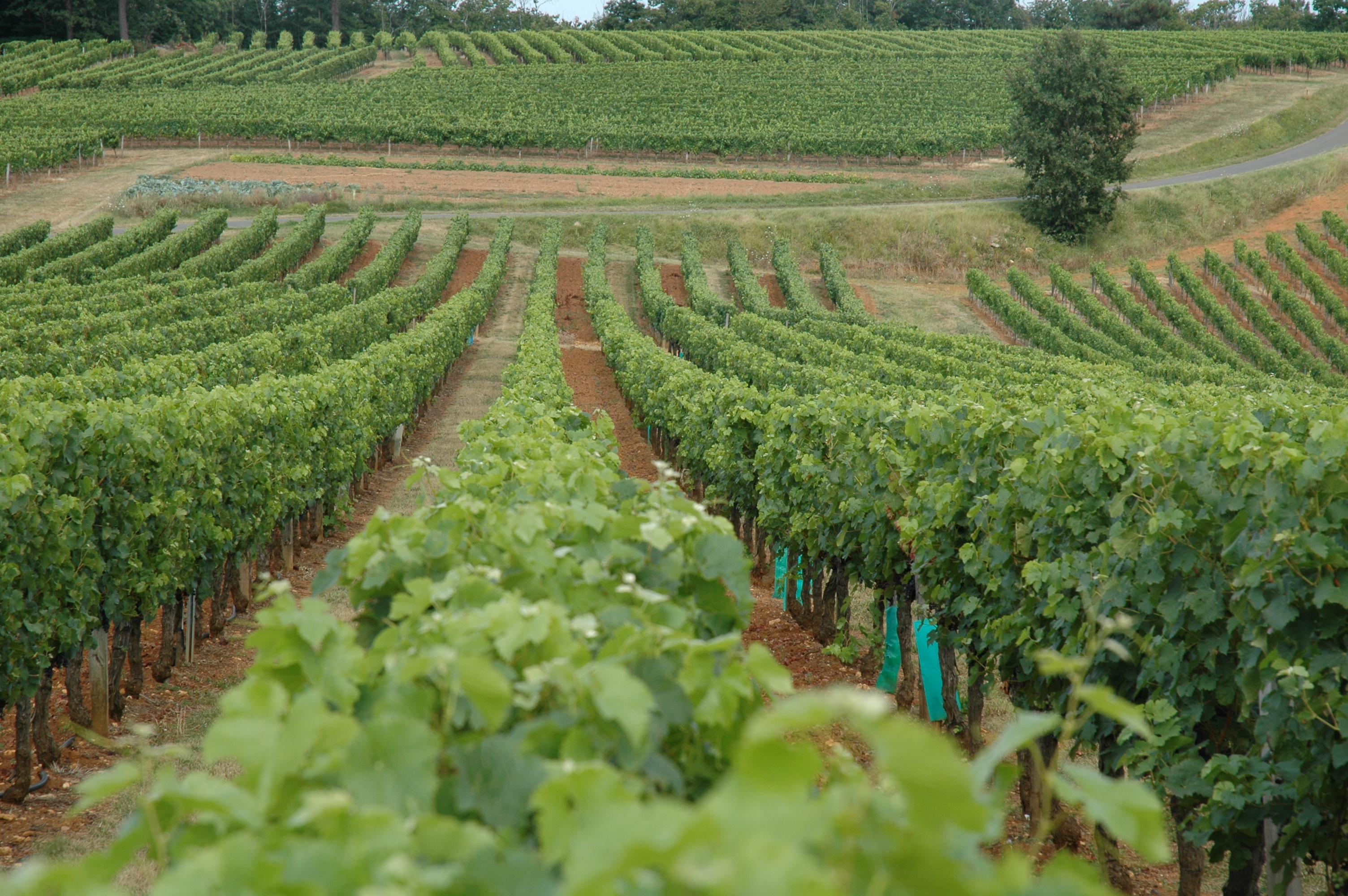
Look beyond the town boundary. These vine rows make agricultural land visible alongside the urban market discussed above. The photographer labels the scene Cahors; the image alone cannot establish a particular parcel’s appellation status, grape variety or ownership. Bennet Summers, Cahors Vineyard, 13 August 2007, CC BY-SA 2.0. Original image unchanged; not a current vineyard-access invitation.
What “black wine” adds—and what it does not prove
The wine sector’s published historical framing discusses an older account by Rouquié that distinguished a darker auxerrois-based wine destined for northern Europe and overseas markets from another type associated with different customers. It also stresses the changing relationship between a wine's name and commerce. These are historically situated descriptions, not instructions for how every modern Cahors must taste. Vins de Cahors: historical framing study, especially pages 1–2 and 14.
The phrase “black wine” is therefore best approached as a question about reputation, description and sales. It should not be turned into a claim that the product is a separate modern colour category: INAO's current presentation identifies Cahors as red wine. Nor does a historical reputation establish that every bottle is heavy, sweet, unusually alcoholic or made by a single ancient technique.
If you choose to discuss a bottle with a seller, ask about that bottle. If you do not drink, the label, a map and an account of the route to market still provide a complete way into the subject. There is no need to turn cultural interest into a tasting obligation or a purchase.
The Lot connected Cahors to a larger trading system
Historian Anne-Charlotte Javonena's research on making the lower Lot navigable examines the stretch between Cahors and Aiguillon, at the Garonne confluence. It explains the commercial importance of reaching Bordeaux and the Anglo-Gascon wine market, while emphasising the works needed to make navigation possible. A river on a map did not automatically supply a practical freight route. Javonena: Navigabiliser une rivière au Moyen Âge.
Draw the relationship as a sequence rather than as one long arrow: production area, loading point, river passage, connection to a larger river, commercial outlet. At each step, ask what could delay movement or change its cost. This is an analytical exercise; it does not claim that every consignment followed an identical route or encountered identical conditions.
A route can be physically possible and commercially difficult. A channel may exist while access to customers remains constrained. The historical framing study explicitly identifies both navigation difficulties and Bordeaux's trading privileges as limits on flows. That distinction helps explain why “near a river” and “well connected to a market” are not synonyms. Vins de Cahors: historical framing study, page 2.
Avoid adding a spectacular export total unless its date, unit and geographical coverage are established. A figure for an entire valley, a port's traffic or a later administrative area cannot simply be relabelled as the output of medieval Cahors. Scale is part of the evidence.
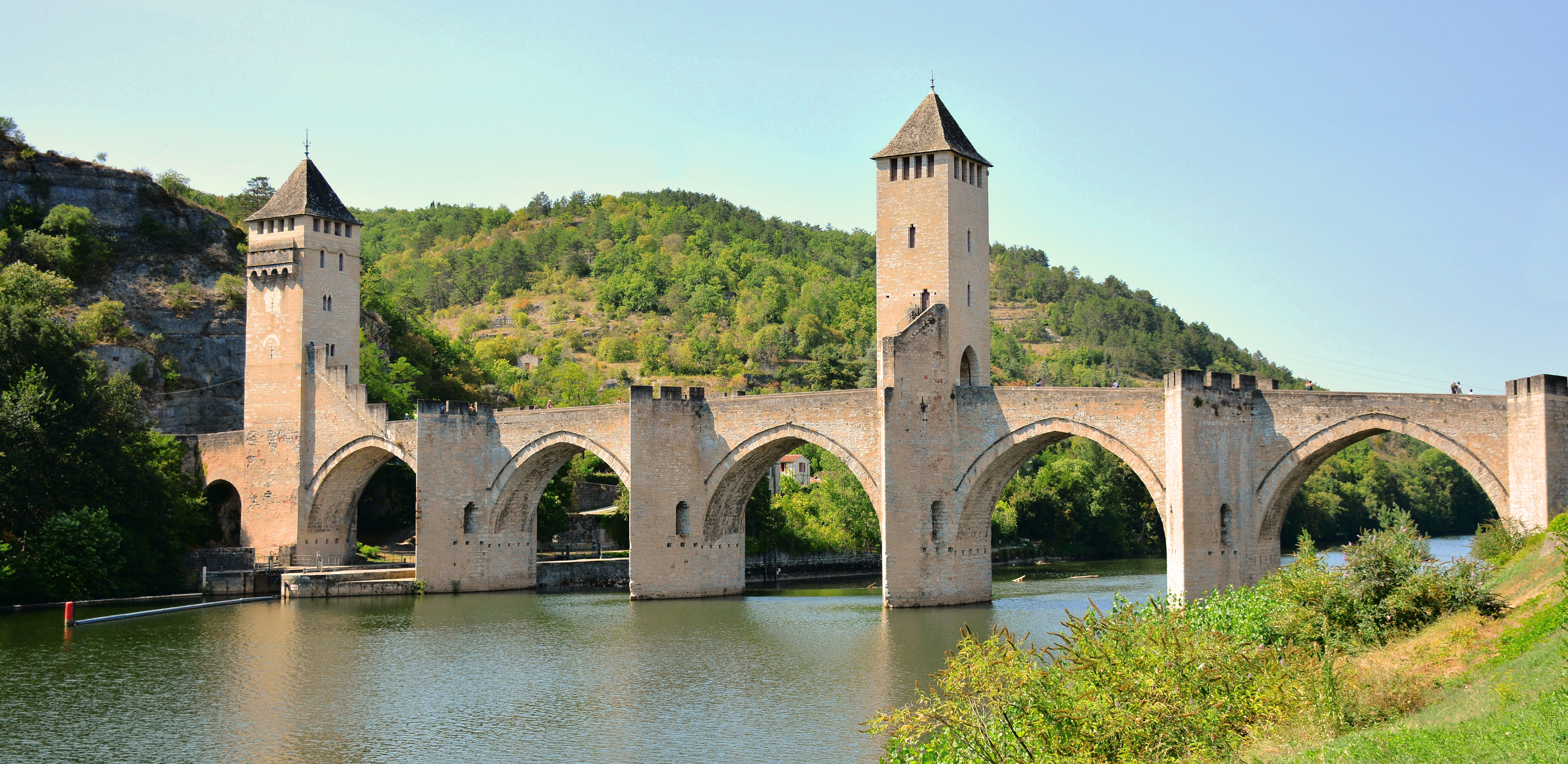
A river view is not a freight record. The Pont Valentré and water below give a spatial reference for the Lot. They do not identify a medieval loading point, prove which cargo passed here or establish navigation conditions today. Mike McBey, Pont Valentré, 20 August 2018, CC BY 2.0. Original image unchanged.
Cahors merchants were not just wine growers abroad
Javonena's separate study of the city's roads, bridges and river describes merchant networks extending beyond local produce. It notes wines originating in Portugal and the Aunis among their trade, with textiles among return cargoes. The city's commercial history is thus wider than a story in which every merchant from Cahors transported only wine grown around Cahors. Javonena: Cahors, three bridges and a waterway.
This changes the meaning of a trading town. Its importance can lie in organising connections as well as producing goods. A merchant's place of origin, a cargo's production area and its final market may all differ. The same town name can appear in a story about people, finance or products without proving that these are the same story.
The study cites municipal and departmental archival material. Those references provide routes into the documentary record; the original manuscripts have not been independently inspected for this article. A visitor pursuing a particular transaction should begin with the relevant citation and ask the archive about access, rather than expecting a general museum display to authenticate every detail.
Continuity includes disruption and rebuilding
The wine sector's historical account dates the arrival of phylloxera in the Cahors vineyard to 1876 and describes the failure of simple like-for-like replanting before grafting onto resistant rootstocks offered a way forward. It also identifies the VDQS recognition in 1951 before AOC recognition in 1971. The modern identity was rebuilt through agricultural work and collective organisation, not merely carried unchanged from the Middle Ages. Vins de Cahors: history.
That makes the everyday objects of production worth attention. A tool can tell a different story from a bottle label: work performed, materials handled, a method adopted or abandoned. But an object needs a date and provenance before it can be used to represent a whole region or century.
For a regional comparison, the privately operated Musée du Vin in Saint-Cirq-Lapopie describes old wine-related objects, an interactive quiz and an olfactory area alongside its shop. It is in Saint-Cirq-Lapopie, not central Cahors, and its own presentation is not proof of a municipal museum status or an independent archive. No particular displayed object has been inspected for this article. Operator's description of Le Musée du Vin.
That distinction is useful rather than dismissive. A retail-linked display may introduce tools and vocabulary; a scholarly study may interpret documents; a municipal notice tells you where the market now operates. Each can answer a different question. None should silently stand in for all the others.
A market-and-river notebook
Instead of collecting a list of supposedly unmissable purchases, make three short records:
| Record | What to write down | What remains unproven | |---|---|---| | A product | Exact designation and the origin stated by its seller or label | That every ingredient or operation shares that origin | | A trading connection | Places linked, period and source identifying the connection | That the route was equally usable in all seasons or eras | | A historical object or image | Location, date, maker or provenance if supplied | That it represents every producer's experience |
For the current market location, use the Allées Fénelon, Cahors address search. This is an orientation link, not a verified map pin, a live stall layout or an accessibility assessment. Confirm the market notice again if visiting after the date of this article's check.
The strongest connection between today's market and the old wine routes is not an invented uninterrupted tradition. It is a recurring practical problem: how a product becomes identifiable, reaches a buyer and survives changes in its surroundings. In Cahors, even a temporary move of the market can make that problem visible.
Source register and limits
Municipal and destination notices, INAO, original scholarly research, sector historical studies and the private museum operator were consulted remotely. Where direct city pages were unreliable, indexed official notices provided the relocation evidence. No original medieval manuscripts, museum objects, interviews or field visits were inspected or performed. The museum comparator is in Saint-Cirq-Lapopie and private, not a Cahors municipal wine museum. Market relocation is dated and has no guaranteed return date. The unchanged vineyard and river photographs establish neither parcel appellation status nor historical cargo or current navigation conditions; no health benefits or tasting obligation are asserted.