Free · France
Moustiers-Sainte-Marie: Earthenware workshops and mountain village life
In Moustiers-Sainte-Marie, a decorated plate can seem to belong naturally to the village around it: pale buildings, steep ground and an abundance of ceramic displays. But the connection is not merely picturesque. Faïence depended on materials, heat, water, skilled work and routes between production and sale. Its place in village life was made and remade, not preserved without interruption.
Read Moustiers through three linked settings: the workshop where a piece takes shape, the water-powered landscape that supported several trades, and the museum where selected objects and histories are preserved. Together they explain more than a shop window alone.
A mountain setting with working resources
The national museum record identifies nearby clay, surrounding woodland for kiln fuel and water used to power mills among the conditions supporting local ceramic production. It places faïence within a wider working landscape that also included paper-making, tanning and other activities. Source: Ministry of Culture, Musée de la Faïence record M0860.
That is a more useful starting point than imagining an isolated artistic enclave. A workshop needs resources and services as well as a talented decorator. The slopes and watercourses are not just scenery around the craft; they help explain why different kinds of work could cluster here.
The official village heritage route associates the Porte du Riou, also called the Porte des Oules, with potters in that quarter. Elsewhere it describes the Adou's role in powering mills and supplying domestic infrastructure. These are related parts of the village story, not a reason to merge every watercourse or industrial site into one location. Source: Moustiers heritage route, sections 02 and 04.
On a walk, ask how a building meets the slope, where water was directed and how a working space connects with a street. Do not assume that an attractive stream powered the nearest workshop, or that a visible channel can be followed safely or legally today.
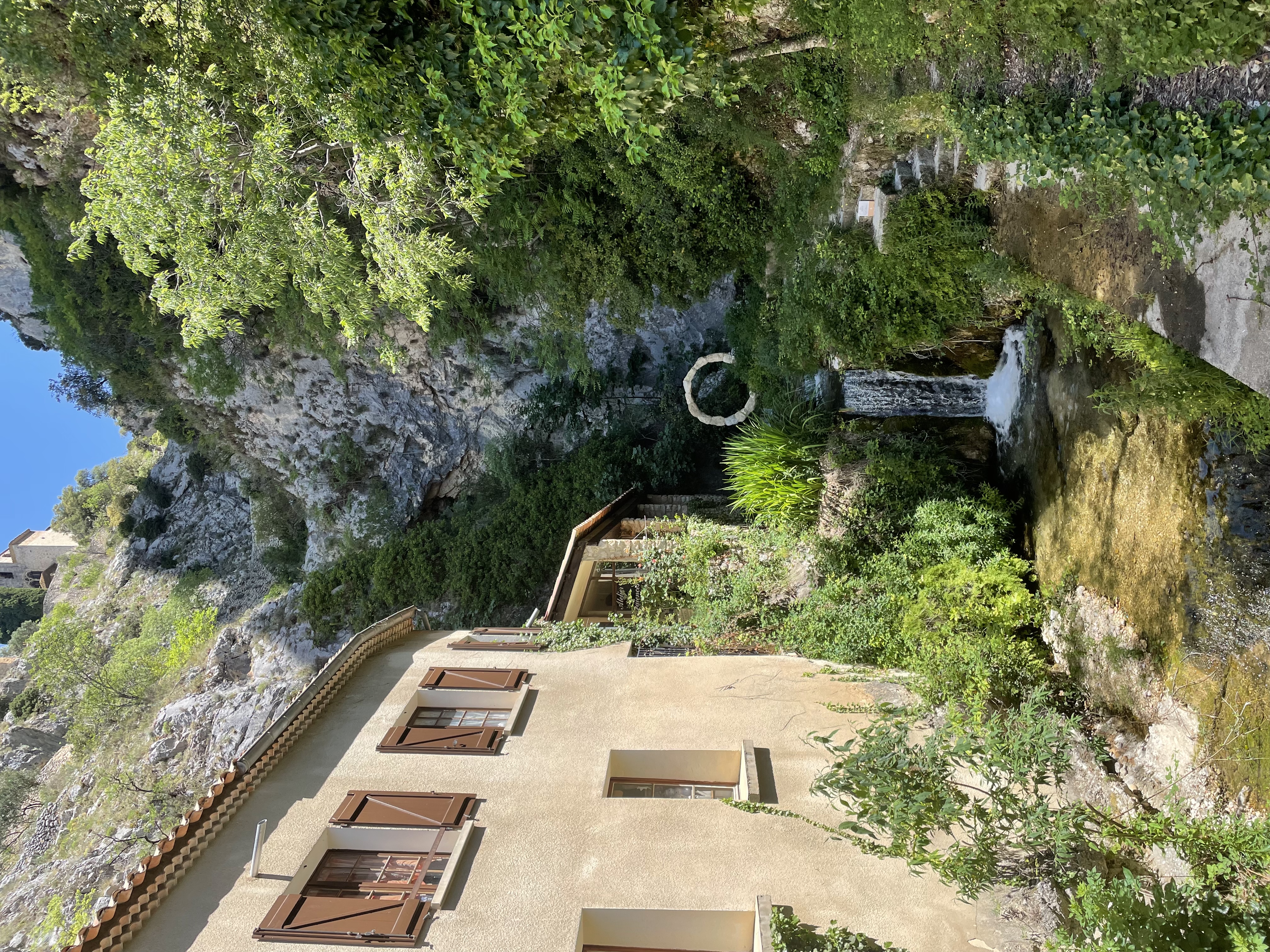
Water and built edges in Moustiers-Sainte-Marie, photographed on 2 June 2022. Landscape context, not identification of the former paper mill, a particular workshop supply or a safe public path. Photograph: Einaz80, CC BY-SA 4.0, original. Original unchanged apart from orientation-aware display scaling.

An old paper mill became part of the ceramic revival
A regional heritage study gives a particularly specific example below the village: a former paper-mill site later used by Marcel Provence for faïence and an École de Clérissy. Its detailed history separates the property and hydroelectric installation sale in 1925 from Marcel Provence’s involvement from 1926 and the training of local young people. It also records a nineteenth-century conflict between industrial users and cultivators over canal water, rather than presenting water as an unlimited shared resource. Source: Région Sud inventory IA04002435, historical study.
The same dossier cites the communal cadastral records E DEP 135/72–73 and water-regulation files S456 and S951 in the departmental archives. Those references were read in the published inventory; the original documents were not examined for this article. They make clear that the site's story rests on property and water-use evidence as well as surviving architecture. Source: same inventory, documentation.
This matters for understanding village life. A channel that serves one activity may also be wanted for another. A building can change use while retaining parts of an earlier infrastructure. The site is identified as private property; its documented history does not make it an open workshop or visitor attraction.
The lesson is not that all local faïence followed this exact route. It is that the revival used an existing village landscape, rather than beginning on an empty stage.
Revival is different from uninterrupted continuity
The Académie de Moustiers gives a useful distinction within the 1920s revival: Marcel Provence began constructing a kiln in 1926 and started making faïence in 1927. Its institutional history describes the formation of the Académie and the opening of a museum in 1929. Source: Académie de Moustiers, institutional history.
Some public summaries compress the revival into one date. Treat those dates as potentially referring to different steps—building, producing, organizing and collecting—not as interchangeable labels. The broader point is secure: twentieth-century revival was deliberate work, involving people who chose to restore production and to study its past.
This makes “tradition” more interesting, not less. A revived practice may draw on old forms and methods while operating in a different economy. Today's makers do not have to be pretending that the nineteenth-century interruption never happened in order to participate meaningfully in local craft.
What happens before the decoration
The official 2025 faïence dossier describes several ways of forming a piece, including throwing and molding, followed by an initial firing, glazing, painted decoration and another firing. It makes clear that the finished pattern is only one part of the sequence. Source: Moustiers tourism office, 2025 faïence dossier, fabrication section.
For a visitor, this gives a better conversation starter than asking only how long it takes to paint a plate. Which stages happen in this workshop? Is the form made here? Who decorates it? At what stage is the piece you are being shown? The questions need not imply that one person must do everything; their purpose is to understand the work accurately.
Nor should a demonstration be expected to compress the entire production cycle into a few minutes. A finished piece, a partly worked example and a short explanation can each show a different stage. Distinguish them instead of assuming that the object entering a demonstration is the one leaving it fully fired.
This is an observational framework, not a kiln-operation guide. Do not handle unfired work, equipment or displayed ceramics without an invitation from the maker.
A museum object connects a name to a dated piece
The Académie's study of local manufactures identifies a 1687 chevrette, an apothecary vessel signed by Pierre Clérissy, in the Moustiers museum collection. The same study warns against treating decorative styles as automatic signatures of a single workshop: attributions can be complicated when makers used related designs. Source: Académie de Moustiers, manufacture history.
A dated, identified object is a stronger starting point than an all-purpose origin legend. It connects a maker, an object type and a documented period. It does not establish the age of every blue-and-white piece sold in the village today.
When comparing historic and contemporary work, look separately at form, decoration and attribution. A modern maker may reinterpret a historical motif without claiming that the piece is an antique. A museum label may use “attributed to” because the evidence is incomplete. Preserve that wording in your notes rather than upgrading it to certainty.
The museum itself offers a film on production techniques alongside its collections. This creates a useful bridge between an object seen in a case and a sequence of work that cannot be observed in the case itself. Source: Musée de la Faïence, visit description.
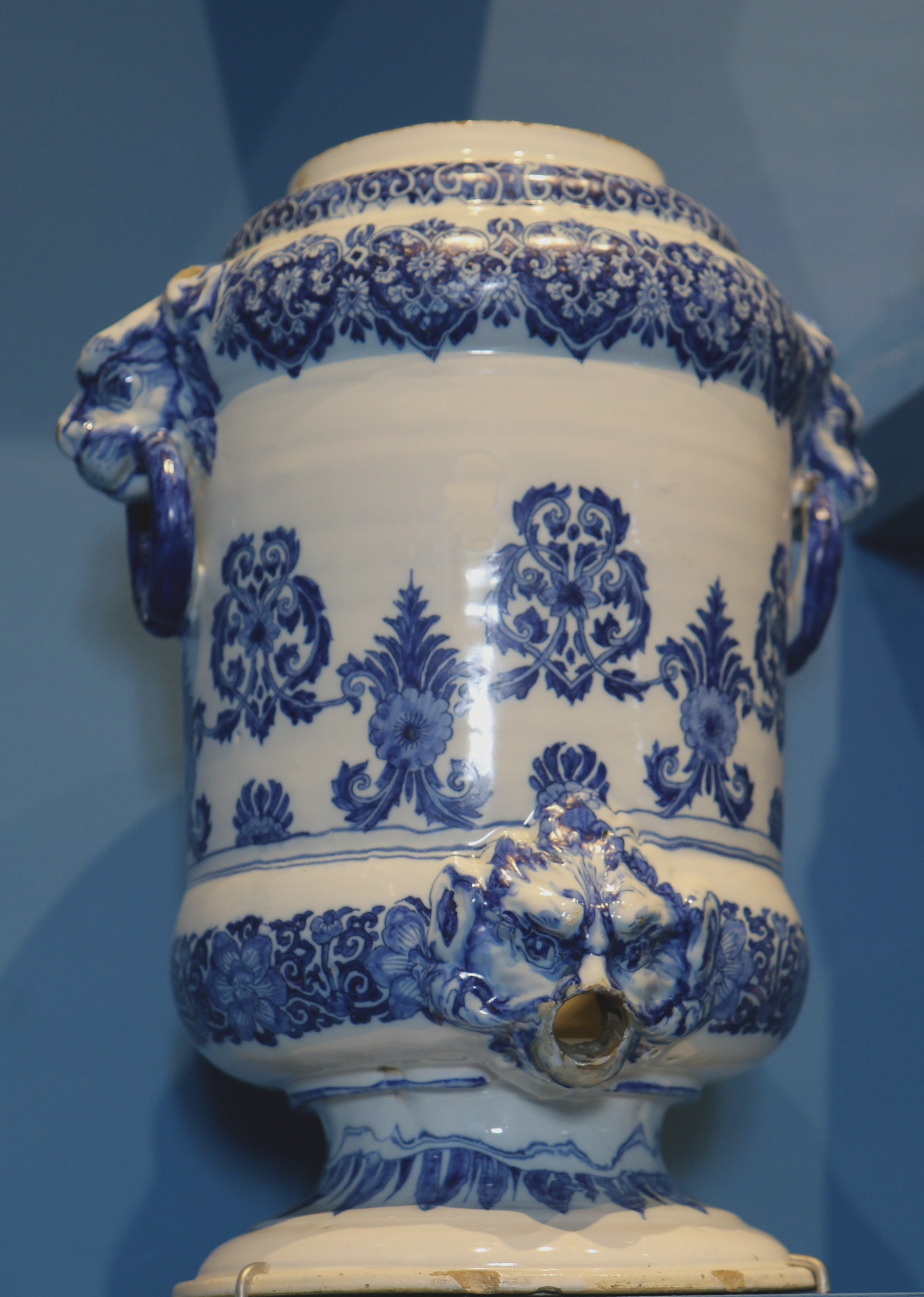
A table fountain identified in the photographer’s record as a Clérissy piece dated 1680–1700, in the Musée de la Faïence de Moustiers-Sainte-Marie. This is not the 1687 chevrette discussed above and not an outdoor village fountain. Photograph: Rvalette, CC0 1.0, original. Capture metadata: 3 November 2018; not a current-display guarantee. Original unchanged apart from display scaling.

Shops and workshops occupy different parts of daily life
The tourism office's current craft overview presents named makers and a mixture of traditional and contemporary work. It is useful as a starting directory, not proof that every listed maker is available for a drop-in demonstration on a particular day. Source: Moustiers, faïenciers and céramistes.
One listing makes the geographical point clearly: Atelier des Cigales is described as an atelier-boutique at the Couvent de Ségriès locality on the route de Riez, rather than simply another counter in the village center. Its advertised work includes decorative faïence and rope-built jars. Source: official Atelier des Cigales listing.
The practical lesson is to check the production address and the sales address separately. A maker's name on a village shop does not tell you where every stage is carried out. Equally, a workshop outside the center is not less connected to the village's craft identity merely because it is not beside the busiest pedestrian route.
For residents and visitors alike, that distinction helps respect working time. Ask about an appointment or demonstration rather than assuming that a retail opening commits someone to interrupting production. The official Atelier des Cigales listing, checked on 29 October 2026, states an annual closure from 15 October to 15 April. It also shows a dated summer schedule; neither is a current appointment confirmation. This article promises no current access: confirm arrangements directly before travelling.
A simple way to compare two pieces
Use this small observation card for a museum object and a contemporary piece. It is not an authentication or valuation service.
| Question | Historic object | Contemporary piece | |---|---|---| | Who identifies the maker? | Museum label or catalogue, with any uncertainty retained | Maker's own description or documented sales information | | What is the form for? | Recorded use, if known | Intended use stated by the maker | | How is the decoration described? | Period terminology and attribution | Current design or acknowledged historical inspiration | | What work is documented? | Evidence from records, object study or interpretation | Stages explained by the workshop | | What remains unknown? | Missing provenance or uncertain attribution | Unconfirmed production stage or material claim |
If a piece is intended for actual table use, ask the maker about its intended use and care rather than inferring suitability from a historical shape. A decorative object and a contemporary utensil may look related while being intended for different purposes.
For general orientation, this Moustiers-Sainte-Marie community map search identifies the village. It is not a verified workshop entrance, accessible route, parking instruction or permission to enter private industrial remains.
Moustiers's earthenware becomes more intelligible when it is returned to the village's working life: resources shared and contested, buildings reused, skills revived, objects collected and makers still making choices. The most rewarding souvenir of that understanding is not a claim that nothing has changed. It is the ability to recognize what a particular piece—and the people behind it—actually represents.