Free · France
Conques: The village's economy beyond religious visitors
A display window can tell you what a visitor is invited to buy. It cannot, on its own, tell you where the object was made, who earns a living from it or how the household behind the business manages winter. That distinction is particularly useful in Conques, where the abbey makes such a powerful first impression that every nearby activity can seem to be an extension of pilgrimage.
The narrower question here is how to recognize making and everyday work behind the village's visitor-facing shops. It does not require pretending that tourism is unimportant. It requires separating several activities that can share one street: production, retail, repair, teaching and hospitality. Their customers may overlap, but their working arrangements need not.
Begin by drawing the right boundary
Conques the historic settlement is not interchangeable with the whole municipality of Conques-en-Rouergue. The municipal site presents four component places: Conques, Grand-Vabre, Noailhac and Saint-Cyprien-sur-Dourdou. INSEE's current geographic record identifies Conques as a delegated commune within Conques-en-Rouergue. A business listed under the larger municipality may therefore be somewhere other than the streets around the abbey. Municipality: territory, INSEE: delegated commune of Conques.
This is not administrative trivia. If you count businesses for the whole municipality but describe the result as the economy of the medieval village, you enlarge the evidence while shrinking the place. A seemingly precise statistic becomes misleading. Conversely, observing only the abbey square excludes work occurring in a workshop outside the visitor circuit.
For any example, write the location in two parts: named settlement or locality / municipality. Then record whether you are discussing a shop, a production address or a registered business. Those can be three different places. A postal address does not establish where every stage of production happens.
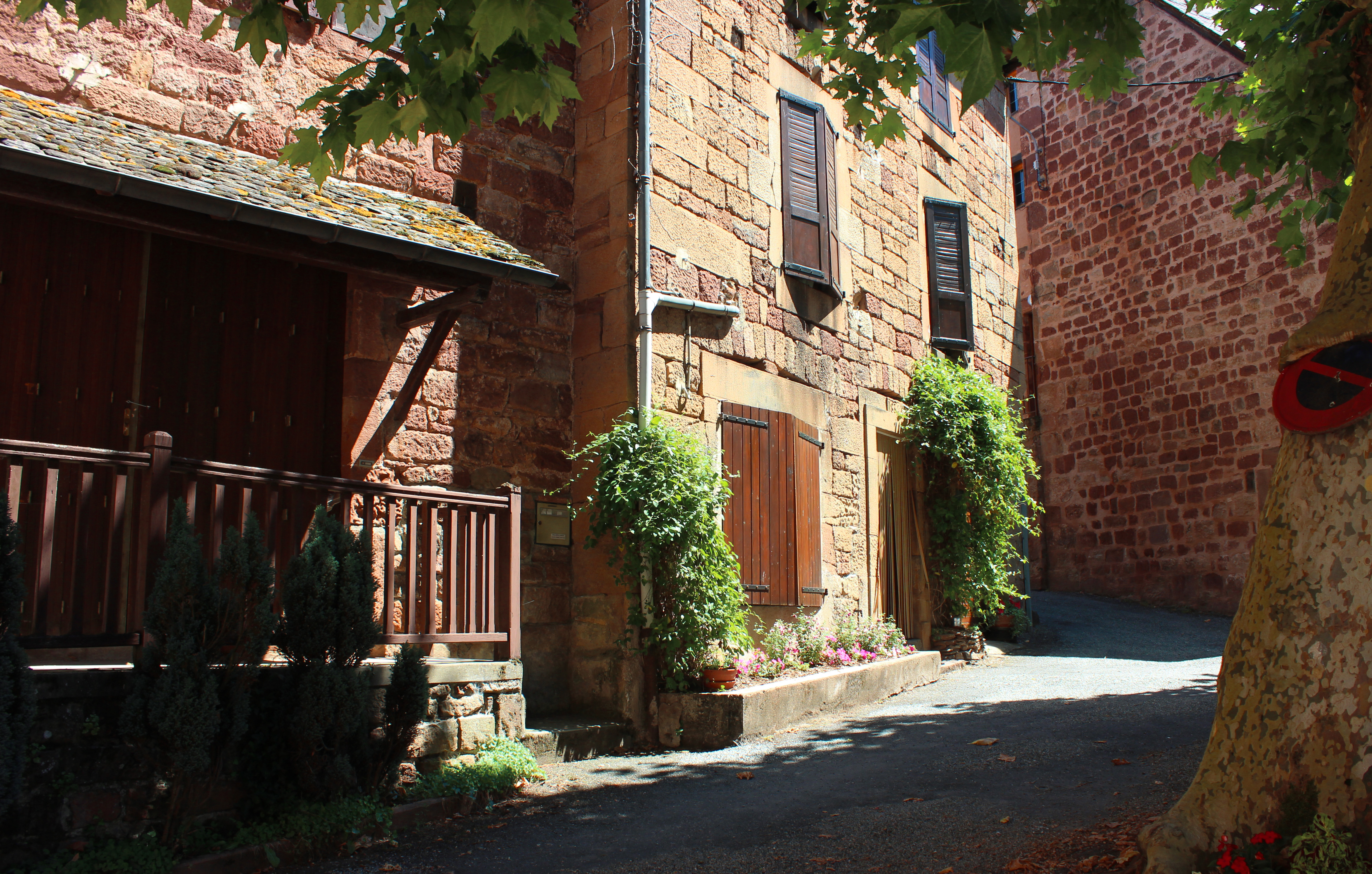
Name the locality before making an economic claim. This street view is catalogued as Saint-Cyprien-sur-Dourdou, not the streets around Conques abbey. It helps hold the article’s geographical distinction in view; it does not identify La Rive’s workshop, a trading address or the work done inside any building. Christian van Elven, Saint-Cyprien-sur-Dourdou, France, 30 July 2012, CC BY-ND 2.0. Original image unchanged and displayed in full; not a current business or access record.
A shop can represent a wider workshop network
The municipal craft directory offers a concrete example of this split. Its La Rive entry distinguishes a seasonal shop in Conques from a workshop in Saint-Cyprien-sur-Dourdou. Other entries describe craft workshops, carpentry and building trades across the municipality. These are directory statements, not a verified census of currently active jobs or turnover; confirm an individual business's arrangements before travelling specifically to meet its maker. Municipal directory: craftspeople and art crafts.
A separate official departmental listing describes O'Fil de l'Art, beside the tourism office, as a collectively managed shop with six makers and artists from the surrounding area. It lists different practices and workshop locations rather than asserting that every object is produced beside the shop counter. Aveyron tourism: O'Fil de l'Art.
The distinction makes a better conversation possible. Instead of asking only whether something is “local,” ask:
- Who designed this particular piece?
- Which processes were carried out in the maker's workshop, and where is that workshop?
- Is the person serving today the maker, another member of a collective or a retailer?
- Can the object be repaired, adjusted or reordered after the visitor leaves?
There is no need to treat an honest answer naming another town as a failure. A regional craft network is still a real network. The misleading step would be to describe regional production as work performed entirely inside Conques village, or to imply that every local seller manufactured every item on display.
This also avoids an unfair assumption about handwork. Visible irregularity is not proof of authenticity, and a polished finish is not evidence of factory manufacture. Attribution, process and the maker's explanation are more useful than a visitor's aesthetic guess.
Everyday work is easier to miss than a souvenir display
The municipality's economic-development page identifies business areas at Saint-Cyprien-sur-Dourdou and Grand-Vabre. Its listed activities include vehicle-related trades, heating and sanitation, agricultural cooperation and food production. These examples show why the wider local economy should not be inferred solely from the commercial frontage of the historic village. The page's land availability and prices are not used here as current offers. Municipality: economic activity areas.
This does not establish that Conques village is economically independent of visitors. It establishes something more limited and defensible: the surrounding municipality contains forms of work that do not fit a simple “pilgrim arrives, buys souvenir, leaves” model. Without accounts, employment data at an appropriate geography or interviews, we cannot assign a reliable share of income to tourism, religious visitors or residents.
A craft purchase may itself combine several markets. The same maker could sell to passing visitors, fulfil remote orders and supply a local customer. That is a possible business pattern, not a claim about the accounts of any named enterprise here. It suggests the right question to ask, rather than supplying an invented answer.
For a reader considering longer-term life in the area, the relevant distinction is service function. Where would a resident arrange a repair, obtain materials or collect an order? Do not assume that an attractive shopping street provides all of these services within walking distance. Start with the municipality's directories, then verify the specific location, opening and appointment requirements.
The historical town was not only an abbey audience
The local heritage service describes a community of merchants and artisans developing alongside the religious institution, with consular government attested in the early thirteenth century. It also locates mills and tanneries by the Ouche and Dourdou, outside the town walls, and identifies a medieval market hall as a centre of exchange. These details broaden the historical picture without turning a current craft shop into a surviving medieval business. Conques heritage service: settlement history.
Notice the geography of work in that account: water-related activities were not necessarily where a present visitor first looks. A useful historical sketch would mark the religious centre, the exchange space and the riverside production areas separately. It would not simply shade the whole village as “pilgrimage.”
Continuity needs evidence, however. The existence of an old tanning activity and a modern leatherworker does not demonstrate an unbroken workshop lineage. Nor does the survival of a street automatically preserve its former economic function. Treat similarities as questions for research: same location, same trade, same institution—or only the same broad material?
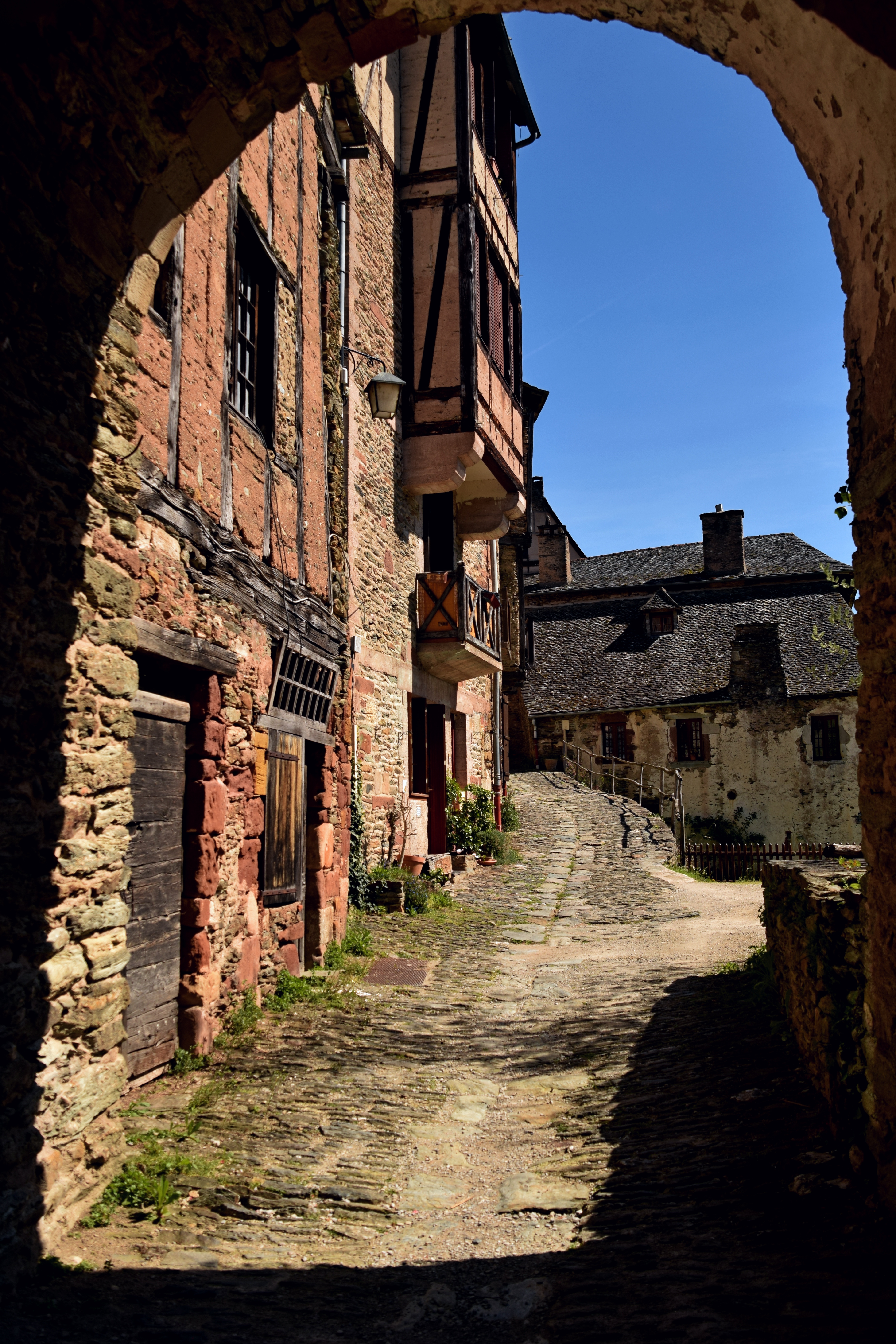
Read the street without inventing its trade. Rue Charlemagne viewed from the Porte du Barry in Conques, 29 March 2017. Compare this village setting with the Saint-Cyprien-sur-Dourdou photograph above: both belong in a discussion of the wider municipality, but they are not the same locality. Surviving doors, walls and a lane do not by themselves identify past workshops, current businesses or household income. This photograph illustrates that limit of visual evidence; it does not identify a named maker’s premises. Photograph: Krzysztof Golik, original and provenance, CC BY-SA 4.0, unaltered.

What an archive and a museum can add—and cannot
An account published by the local heritage service draws on Amans-Alexis Monteil's description of Conques in 1801–1802. It reports his portrayal of hardship after the loss of the former religious establishment's support, together with his proposals for possible manufacturing. The distinction matters: a writer's proposed industry is not evidence that the industry was subsequently built. The original printed volume was not independently examined for this article. Conques heritage history: Monteil's description.
The same heritage resource discusses seventeenth-century woodwork and reused altarpiece elements held at the Musée Joseph-Fau. Such objects can help ask questions about commissions, materials and skilled work. They cannot function as a representative sample of all historical employment. Church-related objects are especially likely to make religious patronage visible; their survival does not prove that secular commissions did not exist. Confirm an object's current display before planning to inspect it.
Taken together, these sources offer three different windows. A historical observer describes conditions through his own concerns. A surviving object records particular work and later collecting choices. A civic directory lists present-day activities for practical purposes. None should be asked to answer every question about the economy.
A small evidence test for a larger claim
Consider the sentence: “Conques lives only from religious tourists.” To test it responsibly, break it apart rather than simply replace it with the opposite slogan.
| Part of the claim | Evidence that would help | What does not settle it | |---|---|---| | “Conques” | A defined village or municipal boundary | An unspecified place name | | “lives from” | Revenue, employment or household-income evidence with dates | Counting attractive shops | | “only” | A sufficiently complete account of other activities | A short visitor walk | | “religious tourists” | A defined visitor survey or relevant customer information | Guessing motives from clothing or walking equipment |
The public sources consulted here justify rejecting the stereotype as an adequate description. They do not justify publishing a replacement percentage. This is a useful result, not a gap to fill with a plausible number.
A reader can still make a modest, evidence-based choice. If interested in supporting a maker, identify a named piece and its production story. If interested in everyday life, locate the relevant service rather than relying on village atmosphere. If interested in economic history, connect a documented commission or work site to its period instead of claiming an uninterrupted tradition.
Keep the encounter proportionate
A shop visit is not an entitlement to inspect a private workshop, photograph customers or obtain a business owner's income details. Ask before photographing work or recording an explanation. A busy maker may be unable to demonstrate a process. A closed door on one afternoon does not establish that a business has failed or that village life disappears outside summer.
Check opening directly for any specially planned visit; a directory's “seasonal” or “year-round” label is not a guarantee for a specific day. The purpose of looking beyond religious visitors is not to replace one romantic image with another. It is to see Conques as a place where making, selling, maintaining and living occupy different spaces—and to describe only the relationships the evidence actually supports.
Location reference
Search map: Conques, Conques-en-Rouergue, France. Village-orientation search only: not a verified business entrance, route or accessibility assessment. Confirm each business's named locality separately.
Source register and limits
Municipal, INSEE, departmental tourism and local heritage-service sources were consulted remotely. No business interviews, site observation, financial-account inspection or direct reading of the original Monteil volume is claimed. Museum evidence is attributed to the heritage service, not an invented curatorial interview or guaranteed display. Historic settlement, delegated commune and wider municipality remain distinct; directory entries are not job counts and no income share or uninterrupted medieval business lineage is inferred. Historical locality photographs show neither named workshops nor current trading conditions.