Free · France
Rocamadour: Village service access across steep streets
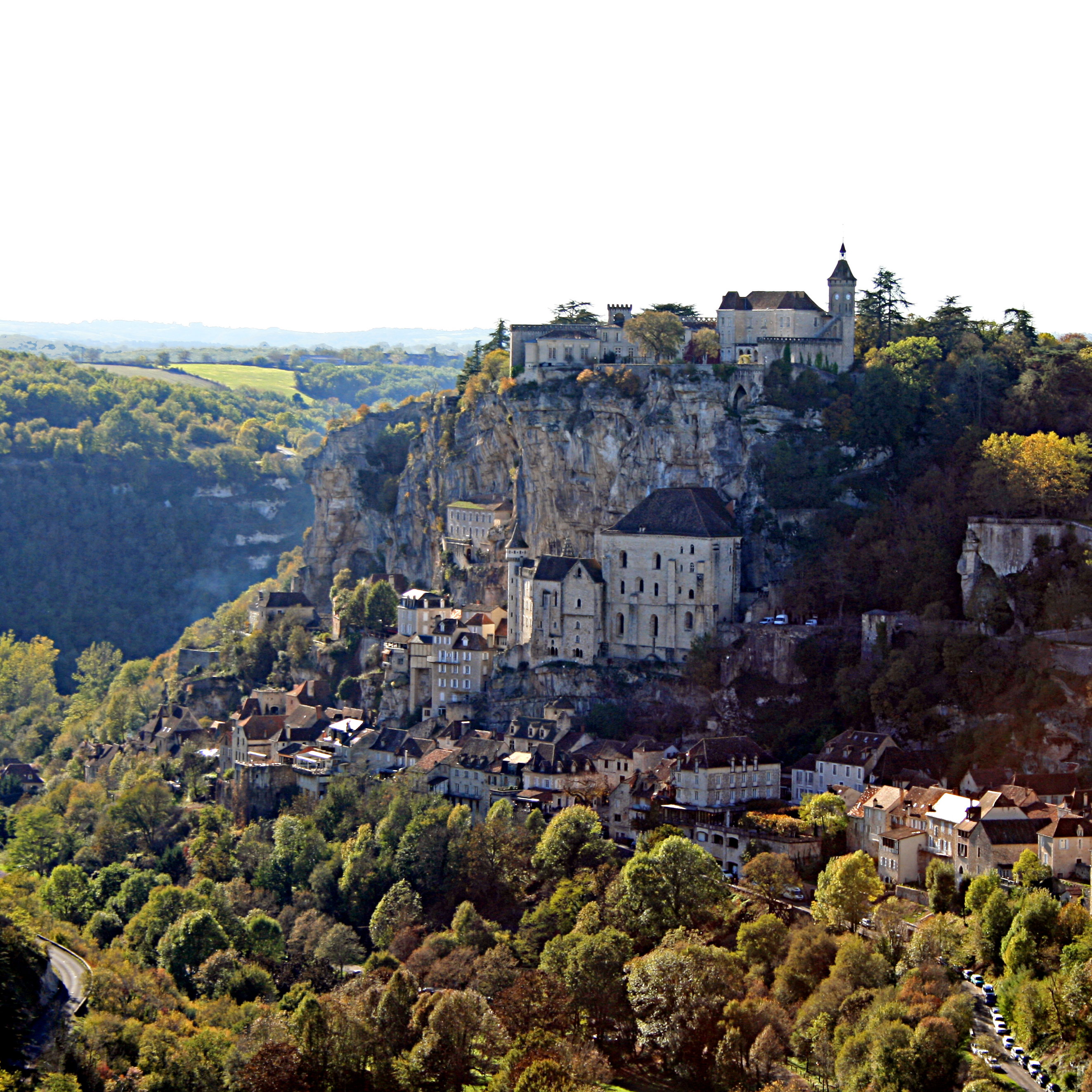
In Rocamadour, “nearby” is not enough information. A destination can appear close on a flat map while lying on a different level, behind a stair or beyond a lift that will close before your return. The practical unit is not distance alone but a complete chain: starting point, level change, destination entrance, opening window and return journey.
That matters for a visitor carrying luggage, a resident collecting a parcel and a person who cannot use stairs. It also matters because Rocamadour is more than its famous cliffside image. The municipality includes the Cité, l'Hospitalet, the station area and numerous other settlements across a wider rural commune. A service with “Rocamadour” in its address need not be on the medieval shopping street. Commune of Rocamadour: municipal description.
One view, several levels. Use this historical overview to see why a single destination label cannot describe every connection. The photograph does not identify today’s lift entrance, postal counter, opening hours or a step-free route. Photo: pom’, Rocamadour, Lot, France, 30 October 2012, CC BY-SA 2.0. Original image unchanged.
First identify which level the journey serves
The tourism office distinguishes two lift links: Château–Sanctuaire and Sanctuaire–Cité. They are separate stages, not two names for one lift. Its description of the valley approach also places the tourist train between the lower parking area and the Cité, rather than treating it as a substitute for every climb above the village street. Vallée de la Dordogne: practical orientation, valley approach.
Sketch the journey as connected points rather than one arrow labelled “centre.” If the destination is on the sanctuary level and your starting point is the Château, identify that particular lift. If you then want the Cité, identify the second stage. A combined ticket, where available, does not remove the need to check the operation of both links.
This is especially important for the return. Going downhill by one route and discovering that the intended uphill connection has stopped can turn a casual visit into a difficult trip. Do not assume that a short stated ride time includes walking to the station, waiting, boarding, reaching the final doorway or returning to your vehicle.
The inclined lift: a useful connection with a dated closure
Solveroc's operator identifies the upper entrance by parking P2, Le Château, and the connection to the sanctuary level. Its practical page, checked again on 28 October 2026, announces a closure for the second phase of a major inspection from 16 November 2026 to 7 February 2027, with the end date subject to change. A general monthly timetable should not be read over that specific notice. Solveroc: hours and access.
The operator's historical account dates the inclined lift's opening to 1989, following tunnel works begun in 1988, and records later modernisation. It is a modern service inserted into a historic landscape, not an ancient route made effortless by nature. Solveroc: infrastructure history.
For a journey during a closure, do not simply replace the lift with a staircase in your plan and call the trip equivalent. The alternative may not suit the same traveller, equipment or load. Confirm an appropriate complete route before committing to a meeting, purchase or accommodation arrangement that depends on it.
Reaching the forecourt is not reaching every interior
The sanctuary's own practical information draws a crucial boundary: access to the forecourt does not mean step-free entry to the chapel and basilica, which it describes as requiring stairs. It also repeats the inclined-lift inspection closure. This specific statement is more useful than a general tourism description suggesting that lifts make the entire site accessible. Sanctuary of Rocamadour: access information.
Ask about the exact destination and your actual requirements. “Can I get to the sanctuary?” may produce a truthful answer about the forecourt while leaving your intended interior unresolved. Better questions specify the doorway, whether there are steps after the lift, and whether an alternative route exists. Do not assume that occasional human assistance is guaranteed or that carrying a person is an appropriate solution for them.
The same principle applies beyond the religious precinct: an accessible vehicle, a public square and an accessible building entrance are separate pieces of evidence. This article provides source-based planning distinctions, not a personalised accessibility assessment or a surveyed step-free itinerary.
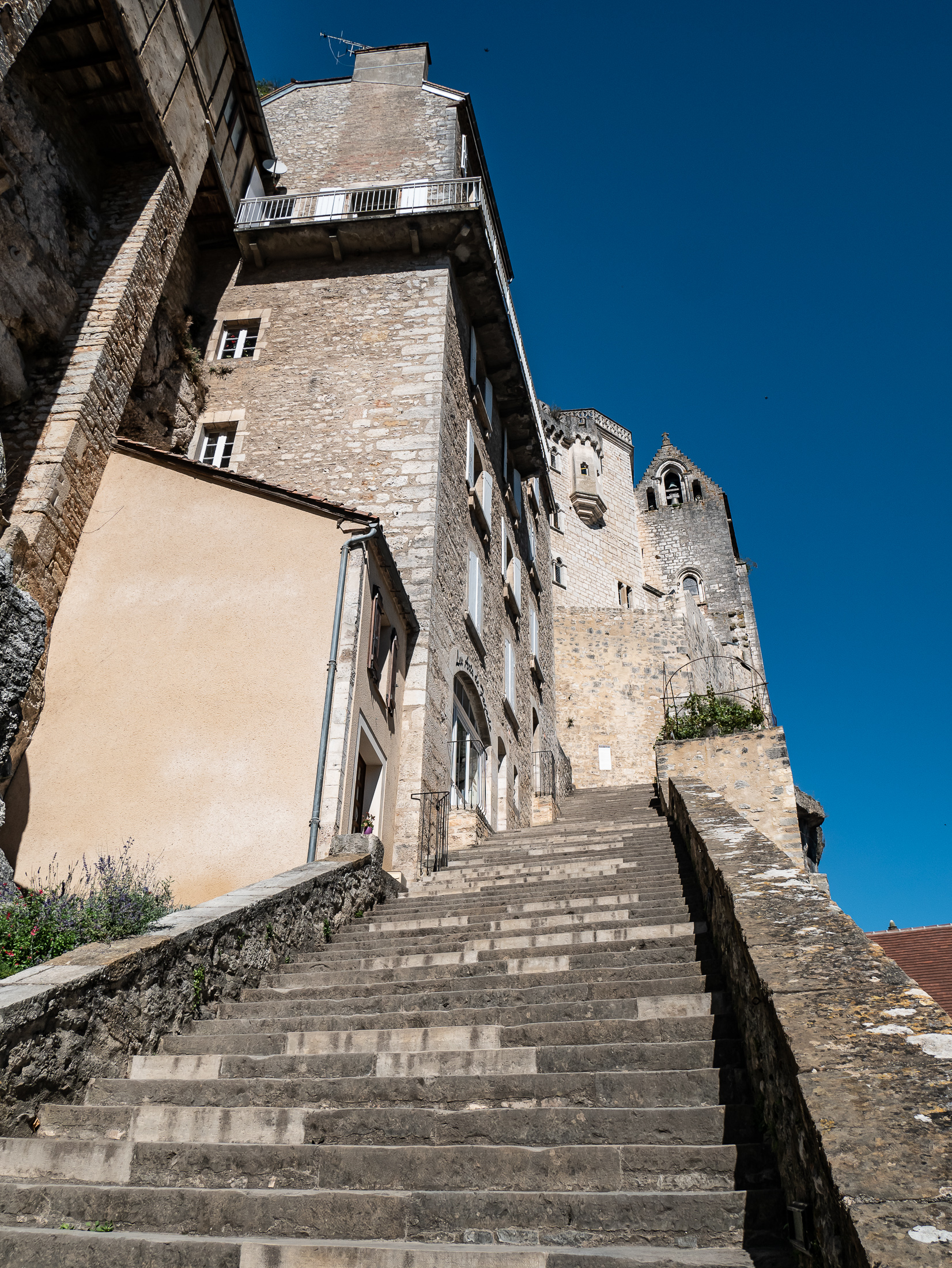
Steps are not an equivalent fallback. This historical view of the Grand Escalier, photographed on 27 September 2017, makes one kind of level change visible. It is not a survey of present surfaces, handrails or access restrictions, and it does not identify a step-free alternative or the final doorway of a particular service. Use it to understand why a replacement route must suit the same person and load, not to plan a current journey from the photograph alone. Photograph: MikeDicaire, original and provenance, CC BY-SA 4.0, unaltered.

Town hall and post: verify the current address, then the particular counter
The municipality now lists its town hall at 46 Couderc de la Mairie. Its services page distinguishes public reception from telephone reception and lists civil-status, planning and other administrative functions. As checked, public reception is shown on Monday, Tuesday, Wednesday and Friday, with Thursday closed to in-person reception. Municipality: services and contact.
The communal postal agency is also listed at that address. Its municipal page gives postal-counter hours separately from those of the town hall. Do not assume that finding the building open means every service inside it is available. Municipality: communal postal agency.
There is a specific discrepancy worth retaining rather than silently resolving: the municipal postal page lists a longer Wednesday opening, while La Poste's locator shows 09:15–11:45 on weekdays, including Wednesday. Both agree on the address. For a time-sensitive Wednesday visit, confirm the counter's actual hours directly. Do not rely on the extra early or late period without confirmation. La Poste: Rocamadour Mairie agency.
A map search for 46 Couderc de la Mairie, Rocamadour helps distinguish this service destination from a generic village-centre result. It is not a verified doorway pin. Before travelling for a particular administrative matter, check the correct service and any appointment requirement rather than relying on the address alone.
The municipal record explains why old information can mislead
The council minutes of 11 September 2025 discussed the new town hall and announced the postal agency's move there for 17 November 2025. They also recorded practical concerns about workers' access during major events and the duration of diversion signs. These minutes are evidence of plans and issues discussed at that meeting; current service pages, not the planned date alone, establish the address used above. Rocamadour council minutes, 11 September 2025.
This is not merely administrative detail. A visitor map or an older bulletin can outlive a service move. In a steep settlement, following an old address can cost far more effort than walking an extra street on level ground. When sources differ, compare what each is: current service page, dated meeting record, historical map or event circular. Keep the disagreement visible until evidence resolves the specific question.
The worker-access discussion also reveals another village geography. A festival visitor and a person delivering goods or reporting for work do not have identical needs. An event's temporary concession or exemption should not be assumed to operate on ordinary days, and a previous year's circular is not a current traffic authorisation.
The station, seasonal buses and the last part of the trip
The sanctuary warns that the railway station is not within the religious precinct and describes a separate journey of roughly five kilometres to it. Treat that as a reminder to plan the final connection, not as a measured accessible walking route. A train ticket to Rocamadour does not include an automatic transfer up the cliff. Sanctuary: arrival information.
The official 2026 liO flyer distributed through the tourism office identifies lines 876 and 877 and states a summer operating period from 1 June to 30 September, with different service days in June/September and July/August. That timetable has expired by the research date of 27 October 2026. It cannot establish an October connection simply because the PDF remains online. liO: 2026 seasonal lines 876 and 877 flyer.
For a current trip, establish the service date, exact stop and return departure with the transport operator. If no valid connection has been confirmed, leave that segment unresolved and arrange a suitable alternative before travel. Do not fill a gap with a guessed timetable or an assumed taxi waiting at the station.
A museum label is not an opening guarantee either
The sacred-art museum provides a compact example of the same access problem. The official tourism listing describes special guided visits to a museum otherwise closed to public entry. A museum symbol or heritage reference therefore does not establish that an ordinary walk-in visit is possible. Vallée de la Dordogne: sacred-art museum access listing.
The distinction generalises without requiring a list of attractions: location, operation and admission are different facts. A building can be present, a route can reach it, and the service you want can still be unavailable. Confirm all three when the journey would be difficult to repeat.
Build a returnable errand, not just an outward route
Use this five-line check for a real task:
- Purpose and exact destination: name the counter, entrance or room, not just “Rocamadour.”
- Starting point: station, accommodation, named parking area or another known address. Do not assume all parking areas are interchangeable.
- Every connection: walking section, lift stage or vehicle service. Mark steps, unknown surfaces and unverified operation honestly.
- Time window: the destination's hours and the last usable return connection. Check closures and event notices for the actual date.
- Fallback: an alternative that suits the same traveller and load, or a decision to postpone. An unsuitable staircase is not a valid fallback for someone who cannot use it.
For a postal errand, the route may be simple once the correct current address is established, but the counter’s own hours—and especially the unresolved Wednesday window—remain decisive. For a sanctuary visit, the lift may solve one level change while leaving the final interior access unresolved. For arrival by train, the largest uncertainty may occur before the village visit begins.
The best plan is not necessarily the shortest line on a map. It is the one whose separate stages have been checked and whose return does not depend on an assumption.
Source register and limits
Remote research used municipal and postal pages, the lift operator, sanctuary, official tourism, dated council minutes and the seasonal liO flyer. No calls, route survey, entrance inspection or booking were performed. Postal Wednesday hours remain in conflict; the summer bus flyer is expired and individual museum admission is unconfirmed. The address-search link is not a verified doorway pin or route. Both photographs are dated historical context, not present service or accessibility surveys.