Free · France
What a Consumer Mediator Can—and Cannot—Do
You have explained a problem to a business, sent the documents and received an answer that does not resolve it. A médiateur de la consommation may be a next step—but not a person who automatically orders a refund because you submitted a convincing complaint.
Consumer mediation is an out-of-court attempt to resolve a dispute between a consumer and a professional over a purchase or service. The mediator helps the parties seek agreement and, if needed, proposes a solution. It is distinct from the business's own customer-service exchange. DGCCRF: consumer mediation.
The practical value is a structured opportunity to explain the disagreement and consider a resolution. This guide helps you understand that process and prepare your record. It does not decide whether a particular claim is admissible, which remedy you are owed or whether a settlement is in your interests. Official sources were checked on 28 October 2026.
First identify the disagreement
Before opening another form, write three short lines:
- The transaction: what you bought or commissioned, from which business, and when.
- The unresolved point: what happened and what the business says about it.
- The requested resolution: the specific action you are asking the business to take.
“Bad service” expresses frustration, but it does not identify the disputed event. “The invoice includes a replacement part that I cannot identify in the accepted quotation” gives someone a point to investigate. That sentence does not prove the charge is wrong; it makes the question precise.
Keep facts, interpretations and requests separate. “The delivery was recorded on Tuesday” is not the same as “I received the parcel on Tuesday.” If that distinction is the dispute, show the two accounts rather than silently merging them.
Make a written attempt with the business first
The Ministry's consumer-rights guidance says you can approach the competent mediator after an unsatisfactory response, or after the business has not replied within two months of your complaint. Keep the written complaint and its date. The same guidance gives a maximum of one year from that written complaint to refer the dispute to the mediator. Check the designated mediator's procedure rather than assuming that any new email restarts a clock. Ministry of Economy: your rights.
A compact first complaint might identify the order, explain the unresolved problem, name the supporting documents and state the resolution requested. This is an original preparation pattern, not a formal legal notice template. Do not add threats or invented legal provisions to make it sound more official.
| Keep in your record | Why it helps | |---|---| | Copy of the complaint as sent | Shows what you actually asked | | Date and available sending or delivery evidence | Anchors the chronology | | The business's response, if any | Identifies the remaining disagreement | | Purchase document and relevant terms | Connects the complaint to the transaction | | Relevant photographs or correspondence | Supports specific facts, rather than replacing an explanation |
An unsent draft is not evidence that the business received a complaint. Equally, several telephone conversations are not a substitute for keeping the written step required for the mediation route.
Two records that answer different questions
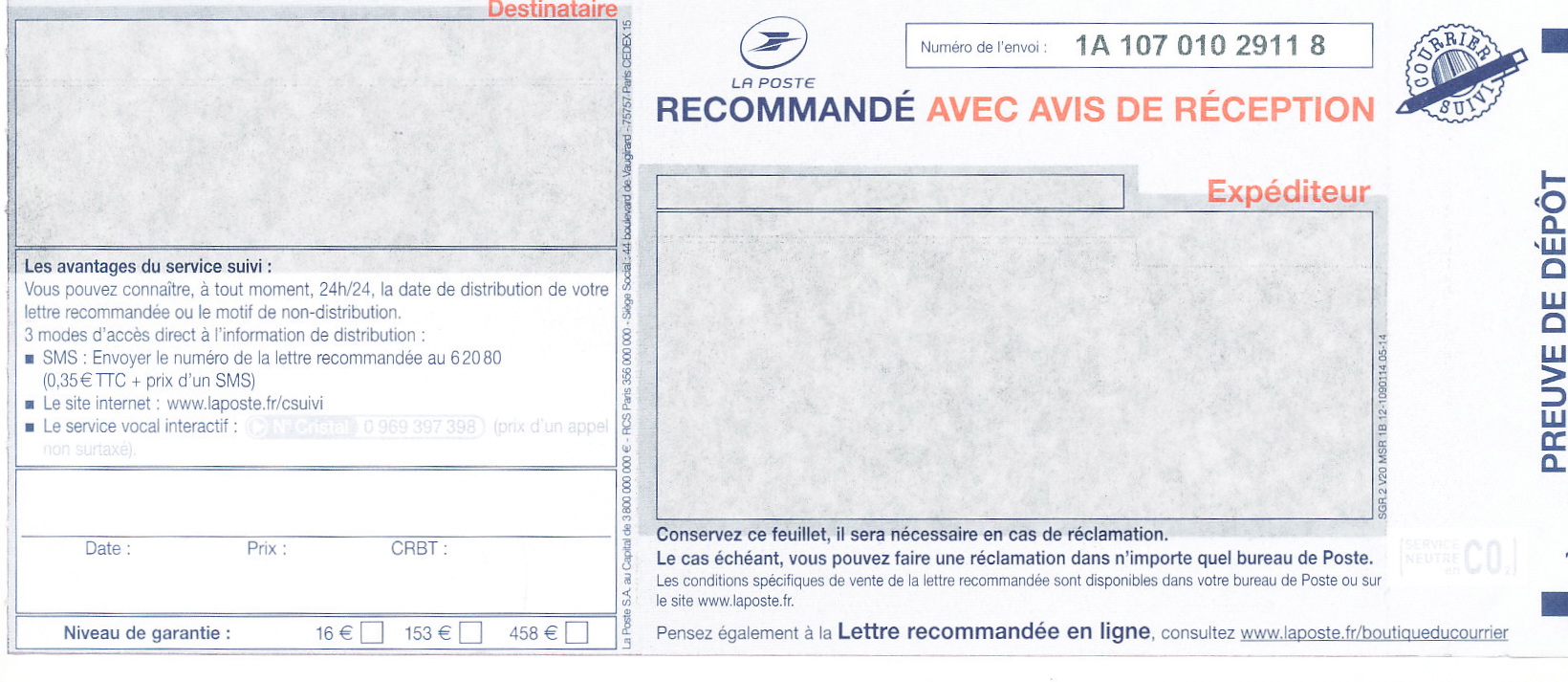
The following are historical scans of blank postal forms, not photographs of a mediation or evidence that any complaint was sent. They help distinguish a posting record from a receipt record. The Ministry describes written complaints by letter or email; these examples do not make registered post compulsory for every mediation route. Follow the applicable procedure.
“Preuve de dépôt” identifies the posting-proof part. A blank example records no actual posting. Scan: Chatsam, 1 April 2015, source, CC BY-SA 3.0. Unchanged original; historical prices, tracking references and contact methods are not current guidance or instructions to use this form.

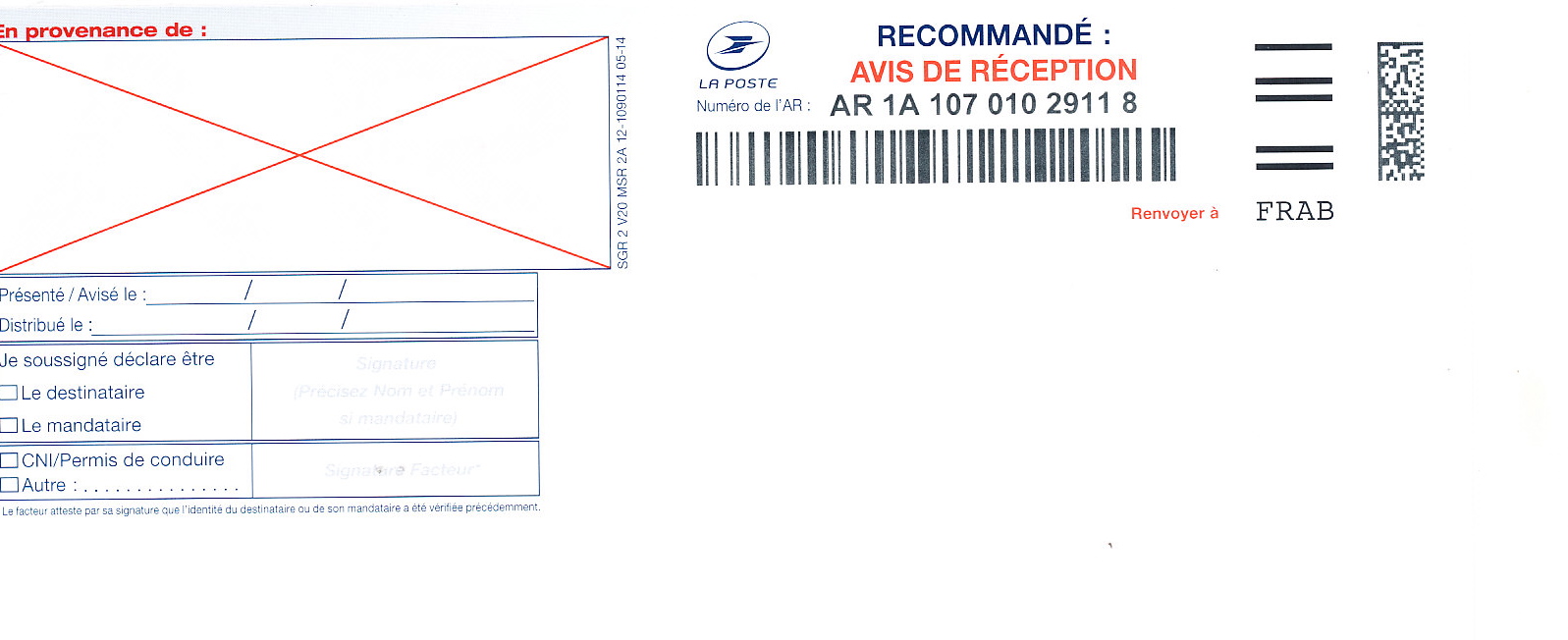
“Avis de réception” is the receipt part, with date and signature fields. Here they are blank: the image proves no delivery. Scan: Chatsam, 1 April 2015, source, CC BY-SA 3.0. Unchanged original; not a current form template. The two scans retain their stated license; no endorsement is implied.

In your own record, keep the complaint's contents alongside the relevant sending and receipt evidence. Do not label an uncompleted form—or proof of posting alone—as confirmation that the business received or agreed with your complaint.
Find the mediator attached to that business
Do not choose an unfamiliar website simply because it promises fast compensation. DGCCRF says to use the mediator designated by the professional. The contact details should be available through the business's website, terms, order documents or another appropriate method, and provided when the earlier complaint remains unresolved. Check the mediator against the CECMC's official list and read the stated area of competence. DGCCRF: identifying the competent mediator.
A useful request is: “Pouvez-vous m'indiquer les coordonnées du médiateur de la consommation dont vous relevez ?” — Could you give me the contact details of the consumer mediator responsible for your business?
A familiar word is not enough: a mediator for a different sector or a different type of dispute is not necessarily the right recipient. This article concerns consumer-contract mediation, not every service whose name includes médiateur.
Admission is a separate decision from the outcome
Under Article L612-2 of the Consumer Code, barriers include no prior written complaint to the professional, a manifestly unfounded or abusive request, a dispute already examined or being examined by another mediator or a court, a referral more than a year after the written complaint, or a dispute outside the mediator's competence. Article L612-2 provides for notification of rejection within three weeks of receipt of the file. Légifrance: Article L612-2.
These are checks, not a self-certification form. If another process is already under way, disclose it and check the applicable route; do not submit duplicate versions hoping one will be accepted. The Ministry notes a specific energy-sector exception to the usual one-mediation principle, so a blanket rule covering every sector would be misleading. Ministry of Economy: mediation stages.
Keep two questions apart: “Can this mediator examine the case?” and “What solution, if any, will the process produce?” Passing the first stage does not answer the second.
What the mediator can offer and what remains your choice
The Ministry describes mediation as voluntary: the parties can withdraw, and they can accept or refuse the proposed solution. The proposed outcome can differ from what a judge might decide. The usual processing period is 90 days from the mediator's notification, with an extension possible for a complex case; it is not a guaranteed refund date measured from your first complaint. Ministry of Economy: mediation stages.
Read a proposal for its actual terms. For example, if an offer combines a payment with returning an item, do not record only the payment amount in your notes. Identify who must do what, by when and subject to which conditions. Ask about unclear language before agreeing. Acceptance has consequences; do not assume you can accept a settlement and then pursue the same dispute as if no agreement existed. Obtain qualified advice if you are unsure about those effects.
The process itself is free for the consumer, but optional paid representation, an expert and postal or copying costs may remain yours. “Free mediation” does not promise that every service you choose around the case will cost nothing. Ministry of Economy: costs and rights.
Do not confuse mediation with a signal to a regulator
SignalConso is another tool. DGCCRF explains that a report is transmitted to the business with a request to respond; the authority retains it and may use reports in deciding on controls. The service can also direct consumers toward an appropriate contact. That is not the same step as a mediator's examination of your file. DGCCRF: resolving a consumer dispute.
Label your records accordingly: “complaint to business,” “SignalConso report” and “mediation referral” should not become three interchangeable names for one document. If a mediator asks for the prior complaint, provide the evidence relevant to that requirement rather than assuming a dashboard screenshot supplies everything needed.
A five-minute readiness check
Before submitting, check the following without treating the list as a guarantee of admission:
- Have I named the correct business and transaction?
- Can I show the written complaint, its date and any reply?
- Have I found the business's designated mediator and checked the stated competence?
- Have I disclosed other proceedings rather than omitting inconvenient history?
- Can a reader identify my requested resolution and the evidence for each disputed point?
Use descriptive attachment names and send what the official procedure requests. Keep originals and avoid exposing unrelated purchases, account transactions or other people's details. A shorter, clearly explained file can be easier to understand than a large pile of screenshots with no chronology.
A mediator offers a process, not a promised victory. Your most useful preparation is a verifiable sequence of events, a clear unresolved question and a realistic understanding of the decision you will still need to make.