Free · France
Honfleur: Old harbour architecture and working waterfront
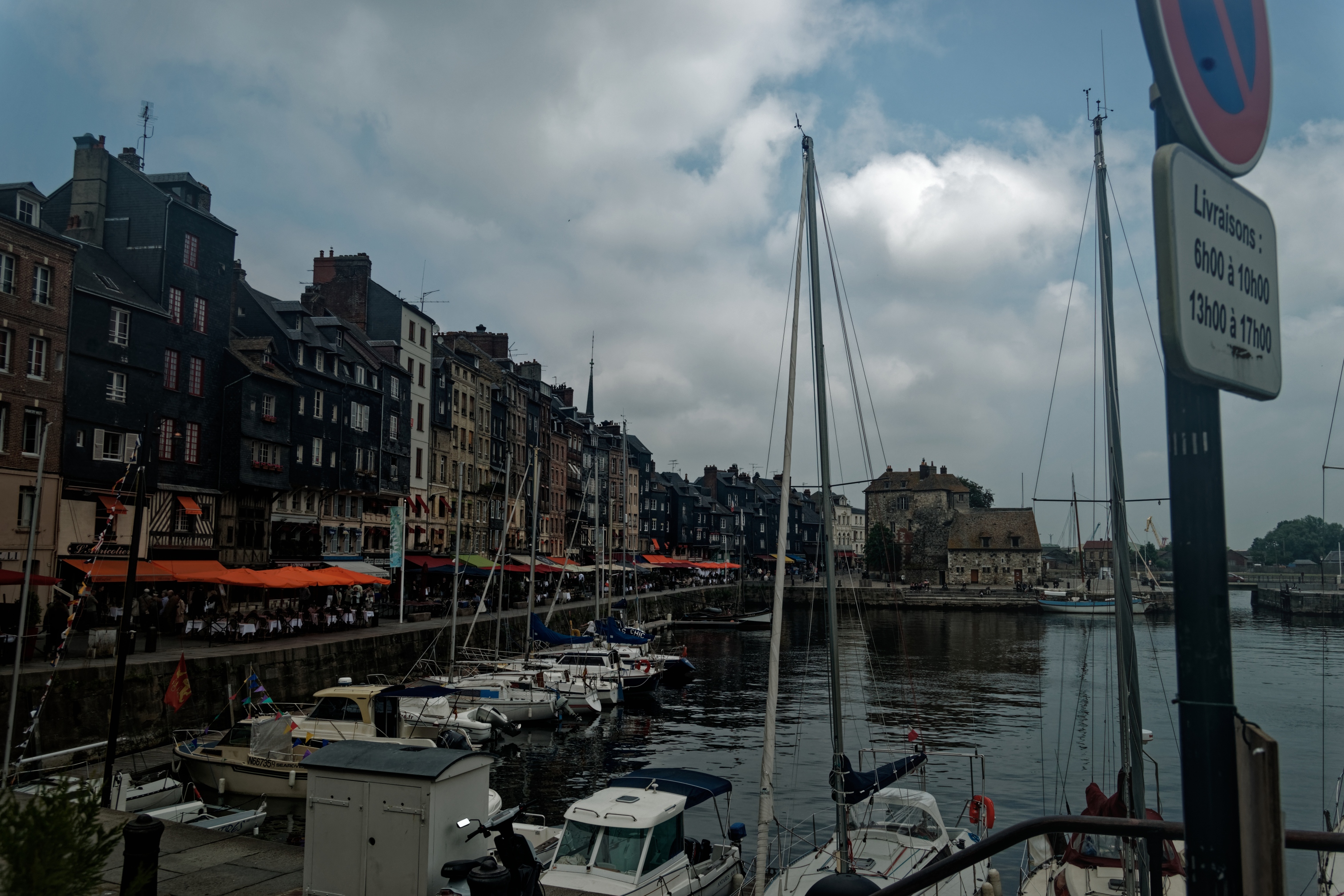
Honfleur's Vieux Bassin can be understood through the narrow boundary where buildings meet harbour water. A quay wall holds back ground; a doorway connects a building to the street; a harbour entrance regulates movement. Together they make something more complicated than a waterfront view. This account follows that boundary around the old basin, concentrating on its walls, the Lieutenance and the Sainte-Catherine frontage. The central distinction is between the survival of a recognisable setting and the survival of its original functions. Honfleur's evidence points to repeated adaptation, not an architectural scene preserved outside working life.
The waterline was made and remade
The city's history of the Vieux Bassin reproduces an engineer's account written in 1875. It describes an earlier harbour within the fortifications where vessels could take the ground, before works transformed it into a basin retaining water. In that retrospective account, the transformation belongs to 1684–1690 and includes lock gates, quay construction and a flushing sluice. This is a sequence of engineering operations, not simply the excavation of an ornamental pool. City of Honfleur, Vieux Bassin history.
The same account dates rebuilding of the Sainte-Catherine quay wall to 1791–1794 and its Saint-Étienne counterpart to 1811–1813. It places the older Saint-Étienne wall behind its replacement, beneath later fill. The edge of the water was therefore not fixed even after the basin had acquired its familiar role. A present frontage and the masonry immediately below it need not belong to one building campaign. Here, an apparently coherent place contains successive decisions about retaining ground and accommodating vessels. City of Honfleur, Vieux Bassin history.
An archival catalogue offers a different scale. The Bibliothèque nationale de France's collective catalogue records a seventeenth-century Plan de Honfleur within manuscript SH 80, a collection of coastal and port plans held by the Service historique de la Défense. Honfleur appears alongside other ports, rather than as an isolated architectural subject. The volume's binding bears Colbert's arms. These details establish the document's institutional setting; the catalogue alone cannot show where a particular surviving wall stood. CCFr, Honfleur plan in SH 80.
The distinction matters. A catalogue identifies an object worth consulting; a civic history supplies a narrative assembled for public understanding. Neither should be treated as a measured survey of today's quay. Read together, they suggest a productive change of viewpoint: the old basin belongs to a wider history of managing ports, not only to Honfleur's collection of memorable buildings.
The Sainte-Catherine waterfront towards the Lieutenance in June 2010. The quay, houses and moorings are adjacent but do not share one construction date. This predates the 2026 safety measures and is not evidence of current access. Photo: Txllxt TxllxT, Wikimedia Commons; CC BY-SA 4.0. Unmodified by publisher.

A gateway became an office
The Lieutenance makes changes of function unusually legible. The municipality identifies it as a remnant of the fourteenth-century fortifications, with accommodation above the porte de Caen assigned to the king's lieutenant from 1683. Its later uses included civic and judicial functions, followed by the Ponts et Chaussées around 1808. In the 1840s, demolition of a lower artillery terrace allowed quay improvements and a road connection between neighbourhoods. The harbour's defensive architecture was being altered to ease everyday movement. City of Honfleur, Lieutenance history.
Port administration was not merely a distant episode: the same history records the harbourmaster's office arriving in 1974 and port services leaving in 2006. The building's antiquity thus conceals relatively recent office life. A useful question is not only which parts are oldest, but what each alteration allowed people to do. Defence, residence, administration and circulation made different demands on the same structure. City of Honfleur, Lieutenance history.
Following restoration between 2015 and 2022, the Lieutenance acquired a maritime heritage interpretation centre and an artists' residence. The city's account notes surviving marks where fortifications were removed to make the Vieux Bassin. Such absences are evidence too: the harbour required dismantling as well as construction. The interpretation programme connects maritime expeditions and shipbuilding with fishing, industrialisation and tourism, while a separate section addresses building materials and conservation. City of Honfleur, Lieutenance interpretation programme.
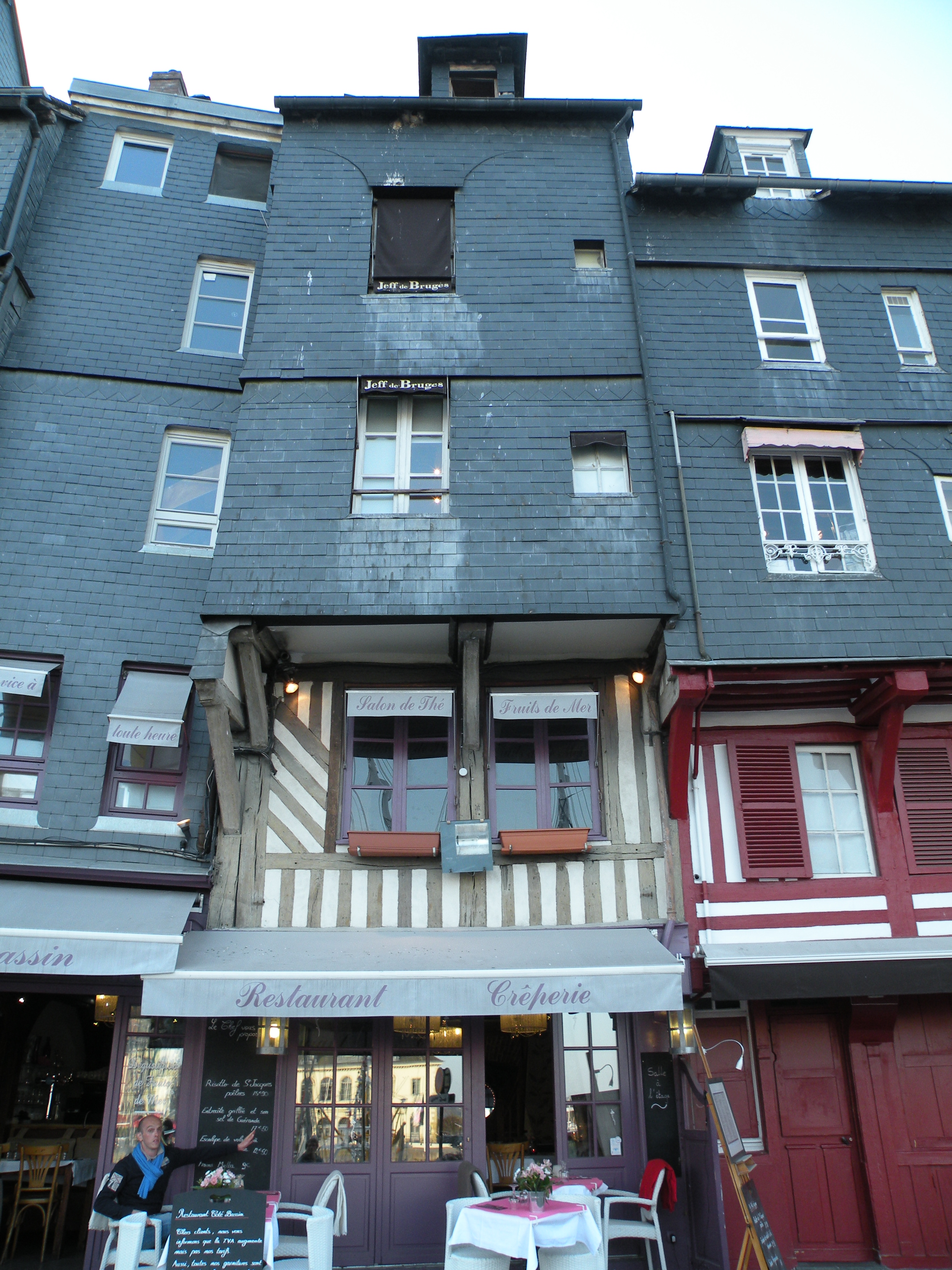
Number 20 quai Sainte-Catherine in April 2012. This is the property identified by PA00111426, not numbers 36–40 discussed in the 2026 incident. The photograph neither identifies early residents nor certifies present structural condition. Photo: Pymouss, Wikimedia Commons; CC BY-SA 3.0. Unmodified by publisher.

One address interrupts the continuous frontage
Across the Sainte-Catherine frontage, an individual building record gives a firmer starting point than a general claim about old harbour houses. The Ministry of Culture identifies 20 quai Sainte-Catherine, formerly numbered 81, as a house whose principal construction campaign belongs to the sixteenth century. Its façades and roofs received heritage registration in 1933; the record identifies private ownership. These are specific statements about one property and the scope of its protection. They do not establish the occupation of its earliest residents. Ministry of Culture, Mérimée PA00111426.
That modest distinction changes how the frontage is read. It is tempting to distribute a single maritime identity across every doorway, calling the whole row fishermen's or merchants' houses. An address-level record asks for a slower account. Dates, ownership and uses must be established separately. Even the change of number warns against attaching an old reference to a present building without checking it. The façades form a shared public view, but they are not one historical household.
The house and quay also demand different units of attention. One record concerns a property; another describes a retaining wall extending along the harbour. Their histories intersect without necessarily coinciding. Repairing the water's edge need not mean reconstructing the houses behind it. Equally, the age assigned to a house cannot date every structure between its doorway and a moored vessel. The waterfront is an assembly of connected parts, rather than a single monument with one birthday.
The museum restores work to the picture
The local museum evidence approaches the basin from objects rather than property boundaries. Honfleur's municipal museum service explains that the maritime collections were brought together in Saint-Étienne church in 1976. Models, objects, maps and plans address fishing, shipbuilding, trade, privateering and the slave trade, while drawings, paintings and engravings trace the changing town and port. The collection description is important because it refuses to reduce maritime history to ships as attractive shapes. City of Honfleur, municipal museum collections.
It also prevents an innocent reading of harbour prosperity. The explicitly named slave-trading history belongs within the interpretation of maritime commerce, not outside it as an unrelated subject. This does not justify attributing a particular house to a slave-trading fortune without documentary evidence. It does mean that commerce should not be used as a comfortably vague explanation for the waterfront's historic wealth. The museum's declared range is broader than a celebration of navigation.
The national museum register adds the history of collecting. Léon Leclerc and the Société du Vieux-Honfleur assembled local furniture, clothing and other objects over time; the ethnographic museum was founded in 1896, and the city took over management in 2004. Its reconstructed interiors include a weaver's room, a printer's room and a sailor's room. These settings bring domestic and craft work into the account of a port town. They are curated reconstructions, however, not interiors documented as surviving unchanged in houses beside the basin. Ministry of Culture, Muséofile M0662.
This is the useful contrast between museum and archive. A model or furnished room can make work comprehensible, while an archival reference can establish a document's identity and context. Neither automatically identifies who lived behind a specific quay-side window. The museum collection descriptions consulted here establish the subjects represented, not the provenance of every displayed object.
The old basin is not the whole working port
The distinction becomes clearer beyond the basin's immediate edge. Normandy's regional inventory documents a sawmill built around 1900, converted into a cardboard factory in 1902 and later into a wood-fibre works. Its supporting records include an early twentieth-century postcard of the Bassin Carnot and factory. This separate industrial site is not evidence that the Vieux Bassin housed those operations. It shows why the architectural history of the old harbour must leave room for work elsewhere in Honfleur. Région Normandie, industrial inventory IA14000805.
The port operator's 2025 guide supplies another kind of evidence: repair services, a shipwright, slipways and waste-water facilities. It also places refuse-sorting containers at the Vieux Bassin and Bassin Carnot. Such provisions are less visually commanding than historic façades, yet they describe a waterfront that needs servicing. This is a dated operational document, not a guarantee that each listed service remains available today. Ports du Calvados, Honfleur guide 2025, PDF pages 3–4.
Leisure boating and waterfront labour are not opposites. A vessel used for recreation can still require skilled repairs and practical support. The relevant distinction is between different purposes and kinds of work, not between a supposedly authentic fishing past and an entirely idle present.
The operator's separate 2025 fishing-port schedule addresses landings, sales declarations and the relationship between a vessel's home port and where its catch is landed. It demonstrates an administrative framework for fishing activity, not the number of fishing boats in the old basin. Keeping those scales separate avoids a false choice between calling Honfleur a working port and recognising the leisure uses of its historic centre. Ports du Calvados, Honfleur fishing-port schedule 2025, PDF page 3.
Conservation reaches across the quay
Events in 2026 made the connection between buildings and water painfully concrete. The city's initial safety notice concerning numbers 36, 38 and 40 quai Sainte-Catherine recorded a closure perimeter, affected businesses and rehousing, together with planned relocation of boats within that perimeter. A structural problem on land therefore altered use of the basin itself. These are the measures reported at the beginning of April, not a description of access today. City of Honfleur, initial Sainte-Catherine safety measures.
On 7 April, the Ministry of Culture described an approved shoring approach intended to protect neighbouring buildings and preserve registered façades and roofs. The announcement established a proposed response, not completed restoration. Later civic updates record partial reopening of place Berthelot in June. The sequence illustrates why a heritage designation and an attractive exterior cannot substitute for maintenance or establish current safety. Ministry of Culture, 7 April 2026 announcement; City of Honfleur, incident chronology.
Honfleur's old harbour is most revealing at these points of dependence. The water's edge needs retaining walls; historic buildings need continuing care; vessels require services; the museum needs documented objects to explain work that a façade cannot show. The Vieux Bassin's identity lies partly in this continuing negotiation. Its architecture is neither an untouched remnant of maritime labour nor merely scenery after labour has gone. It is a built setting whose uses, responsibilities and material limits keep changing.
Locate the town
For regional orientation, open a Google Maps search for Honfleur. This community-level search is not an exact building entrance, a verified walking route or permission to enter a workshop, museum or private property. Check the institution’s own current access information separately.