Free · France
Granville: Seaside resort culture beyond summer tourism
A seaside building with a different season
Granville's former resort theatre offers a useful correction to the idea that a seaside town becomes culturally inactive when summer ends. The Archipel describes its main performance season as running from September to June, with cultural engagement extending beyond the performances themselves. The venue operates within the former casino complex beside the beach. The same address can therefore be read through two calendars: the holiday season which helped establish the resort, and the cultural season which gives the building another public purpose. Archipel, institutional history
The important feature is not simply that an old building has found a new use. Entertainment was already part of the casino. What changed was the way the theatre could address the town: through a programme, educational work and municipal involvement that cannot be explained only by the arrival of summer visitors. Following this particular room and its institutional setting makes the resort's afterlife more concrete than a list of things to do outside the holiday months.
A resort was an organised social environment
Sea bathing in Granville did not begin as an activity requiring only a beach. The regional inventory cites a departmental deliberation of July 1795 recording a request to stay in Granville while a wife took sea baths for illness. It also dates the Paris railway connection to July 1870. These are different stages in the town's relationship with visitors: an individual request connected with a cure is not evidence of a mass holiday industry. Région Normandie, Granville survey IA50002801
Such evidence helps keep a familiar historical narrative in proportion. Medical bathing, travel and entertainment did not arrive as a single package on one opening day. Nor does a historical claim about the benefits of bathing establish a medical fact. Here it matters because it helps explain why facilities were created around a shoreline and why the town became involved in their organisation.
The inventory's casino study describes the first wooden Salon des Bains as a municipal undertaking of 1828, intended to be dismantled after the season. It records balls supported by residents' subscriptions and a town subsidy, with admission dependent on a card issued by the mayor and the establishment's commissioners. Leisure was therefore already connected to local administration, funding and rules of entry. The same study dates municipal acquisition of the later casino to 1991. These episodes do not amount to uninterrupted municipal management, but they challenge a simple division between private holiday pleasure and public town life. Région Normandie, casino study IA50002804
What the museum preserves about the beach
The local museum approaches resort culture through things collected and images circulated. Its 2025 exhibition, Bons Baisers de Granville 3, presented the history museum's collections at the Musée d'art moderne Richard Anacréon. The accompanying interpretation explains the changing bathing cabins, regulation of the beach and the production of souvenirs for visitors. It places the resort alongside, rather than in place of, the fishing town. Musées de Granville, 2025 exhibition account
This changes the question asked of the casino. Instead of seeing it merely as a landmark marking the edge of the sand, we can ask how it participated in a social world which also needed changing places, acceptable behaviour and images to take home. The museum does not provide a census of everyone who used the beach. Its selected objects and interpretation reveal how the place was represented and organised, not the complete experience of every resident.
That distinction is especially important when attractive resort images outlast the conditions which produced them. A souvenir can preserve an ideal summer while suppressing the inconvenience of work, expense or exclusion. Treating it as evidence of representation, rather than as a transparent view of daily life, leaves room for the less photogenic institutions behind the holiday.
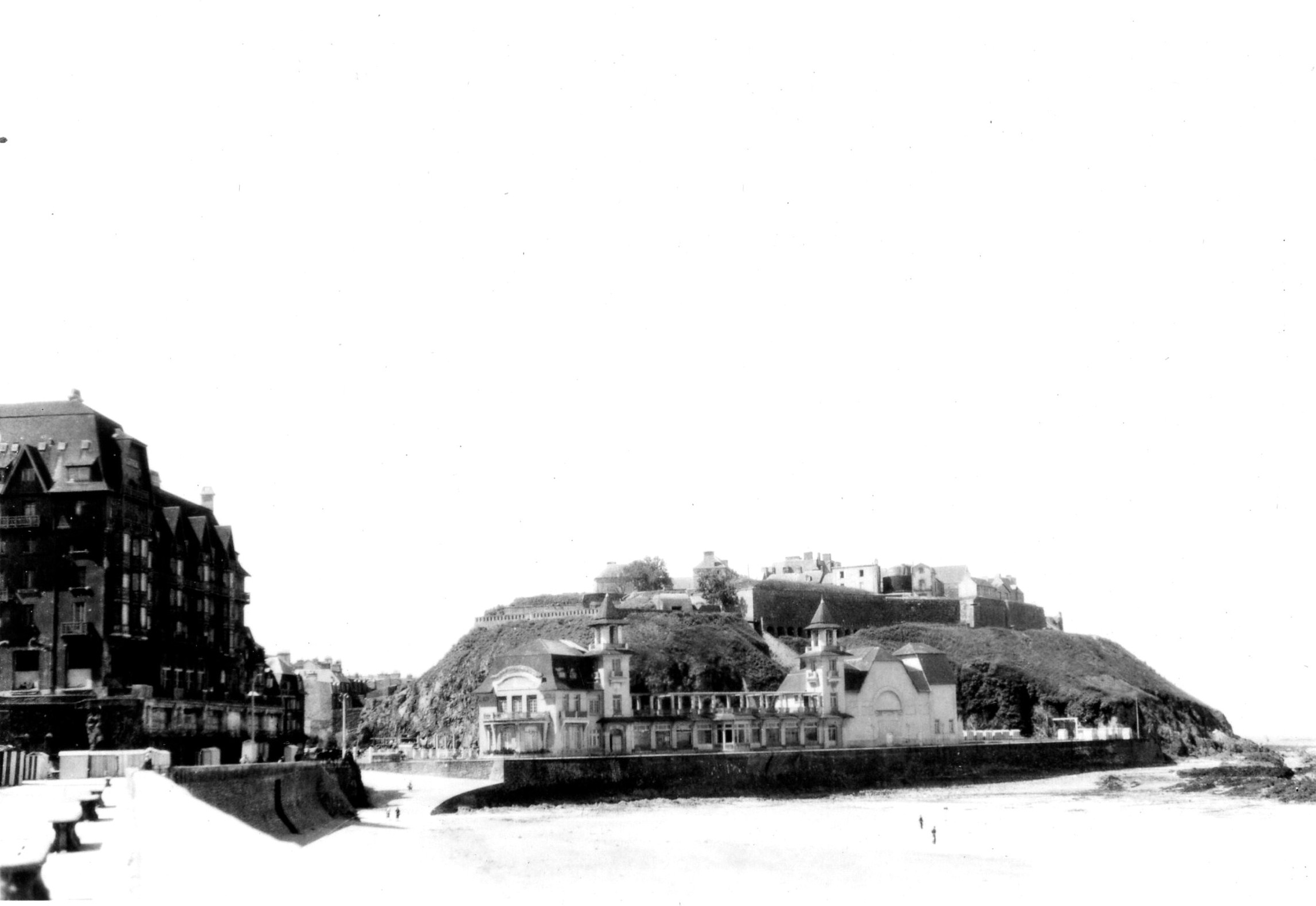
The casino and Plat Gousset beach in June 1948, photographed by Jean Bazard. This separately licensed family-archive image is not either of the Lelièvre items cited in the article; its visible shoreline does not establish a historic bathing timetable. Photo: Jean Bazard; licensed by heir Jean-Pierre Bazard (Jpbazard), Wikimedia Commons; CC BY-SA 3.0. Unmodified by publisher.

An archival image is not a timetable
An archival finding aid in Caen offers a precise example of that caution. The Léon Lelièvre collection includes item 4Z 244, catalogued as Granville's casino and beach at high tide, and 4Z 245, the beach at bathing time viewed from the Grèves. Both carry the date range 1890–1903. The catalogue entries were consulted here, not the original images. Caen municipal and community archives, Fonds Léon Lelièvre, inventory 4Z, p. 33
Even their titles reveal a useful selection. One identifies a water condition; another identifies a social moment. The beach was something people pictured at particular times, not simply an empty strip of land. Yet neither catalogue title demonstrates how frequently bathing took place, who could afford a stay, or what happened inside the theatre that evening. Those questions would require other records.
The difference between a collected image and an operating account matters for the present too. A photograph of a preserved façade does not tell us whether a room is open, what activity it supports, or who feels able to enter. The history of resort culture needs both its familiar images and evidence about actual arrangements.
Preserving the building did not freeze its uses
The Ministry of Culture's record dates the casino's principal construction to 1910 under Auguste Bluysen and describes a decorative scheme subsequently updated between 1925 and 1930. It identifies municipal ownership and specifies partial historic-monument protection in 1992, covering the façades, roofs, campaniles, pergola and decorated former entrance hall. That precision matters: protected features should not be confused with a guarantee that every interior remains in its original condition. Ministry of Culture, Mérimée PA00110661
Architecture and institutional history also have different turning points. The theatre's own account records closure for safety reasons in 1975 and the Archipel's inauguration on 13 November 2001. It describes today's seated auditorium as having 440 places. These figures and dates belong to different configurations, not to one unchanged room serving identical audiences across a century. Archipel, history and auditorium
Reuse is consequently not a story in which heritage survives untouched because a new programme is added. It involves deciding what can remain, what must change and what kind of activity the building can support. The records consulted establish the broad transition, but not the detailed conservation choices or the views of people affected by the works.
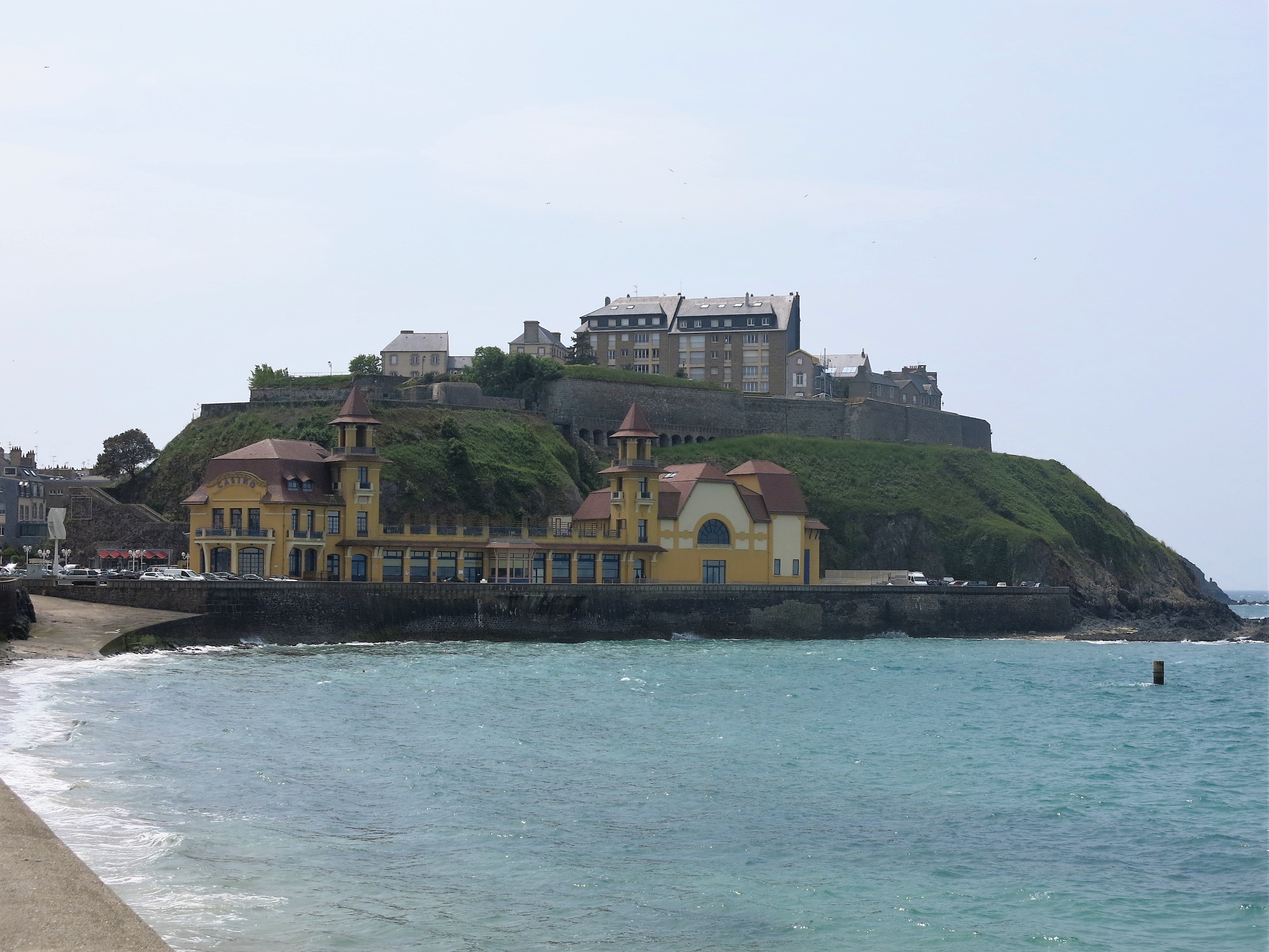
The casino complex in May 2016, with the Pointe du Roc above it. Comparing this exterior with the 1948 view helps locate the inherited seaside setting; neither photograph demonstrates the auditorium’s layout, programme or accessibility. Photo: Tangopaso, Wikimedia Commons; Public-domain dedication (PD-self). Unmodified by publisher.

A public beyond the holiday audience
The clearest evidence of a changed relationship with the locality is the Archipel's educational offer. Its cultural-practice page describes performances reserved for pupils during school time, with teachers invited to select suitable work for different ages. The stated aim is to enable children from the Granville area to attend a performance. This is an institutional objective, not proof that every child has already done so. Archipel, cultural and school activities
The distinction between a school audience and a resort audience is not a distinction between worthwhile and frivolous culture. It concerns how attendance is organised. A holidaymaker may choose an evening's entertainment while already staying nearby. A school visit requires a relationship with teachers and a place within the working week. The room's meaning changes through those arrangements even when the sea remains just outside.
Nor should “public” be taken to mean automatically accessible to everyone. The theatre's practical-information page publishes differentiated tariffs, subscription arrangements, wheelchair provisions and a listening-assistance system. It also warns of difficult parking near Place Foch on performance evenings. Read as institutional evidence rather than booking advice, the page reveals a cultural venue dealing with cost, physical access and urban movement. Archipel, practical information, consulted October 2026
These provisions do not establish whether every barrier has been overcome. They do identify barriers the operator recognises. That is more informative than assuming that a restored building, by itself, creates an inclusive cultural life. A usable venue depends on procedures and assistance as well as an auditorium.
Municipal culture is also administrative work
Granville's detailed council agenda for 17 April 2026 included appointment of municipal representatives to the board of the EPIC Archipel, the local public industrial and commercial establishment. An agenda is not the final record of who was appointed, so it should not be used to invent the outcome. It does establish that the theatre's governance was a matter of municipal business. Ville de Granville, council agenda, item 2026-04-DL-25
This administrative trace brings the argument back to the resort's social infrastructure. The seaside building does not acquire a civic life simply by being old, handsome or locally loved. Institutions make decisions about its use and representation. The evidence does not justify claiming that current arrangements reproduce those of the nineteenth century. It shows something narrower and more interesting: public organisation appears at different stages in the building's history, with different purposes and mechanisms.
Granville's resort culture therefore extends beyond summer tourism not because the town has escaped its seaside identity, but because inherited spaces support relationships that are not seasonal holiday transactions. The Archipel is a particularly clear example. Its setting remains part of the resort landscape, while its cultural calendar, school work and municipal governance give that setting another rhythm. Understanding that combination makes the building more than a preserved backdrop. It becomes a way to see how a town continues to use, and renegotiate, the infrastructure of leisure.
Locate the town
For regional orientation, open a Google Maps search for Granville. This community-level search is not an exact building entrance, a verified walking route or permission to enter a workshop, museum or private property. Check the institution’s own current access information separately.
Source register and boundaries
All sources accessed 2026-10-27. Claim-adjacent URLs above are the consulted sources.
- Région Normandie, IA50002801 and IA50002804: opened inventory studies; historical archival references are mediated through the inventory, not direct inspection of the original letters, regulations or plans.
- Musées de Granville, Bons Baisers de Granville 3: opened institutional interpretation of a 2025 exhibition; not a claim that the exhibition remains open.
- Caen archives, Fonds Léon Lelièvre, 4Z 244–245: opened PDF finding-aid text; original images not examined.
- Ministry of Culture, PA00110661: opened building record and specified protection scope, not the complete protection dossier.
- Archipel, institutional history, cultural practices and practical information: three opened operator pages; programme purpose and arrangements, not measured attendance or an independent accessibility audit.
- Granville council agenda, 17 April 2026: opened proposal-level municipal record; no claim about the resulting board appointments.
Remaining gaps: Original bathing regulations, casino accounts, historic audience records, construction drawings and the 1991 acquisition deed were not consulted. No attendance survey establishes the balance between local and visiting audiences. The inventory's documentation annex, its linked image and the theatre's 2021 administrative PDF were unavailable and excluded. No institutional object photographs or historic plans were directly inspected; the two separately licensed contextual photographs above are distinct. This article is not current ticketing advice.