Free · France
Saint-Cirq-Lapopie: Lot river cliff village and merchant history
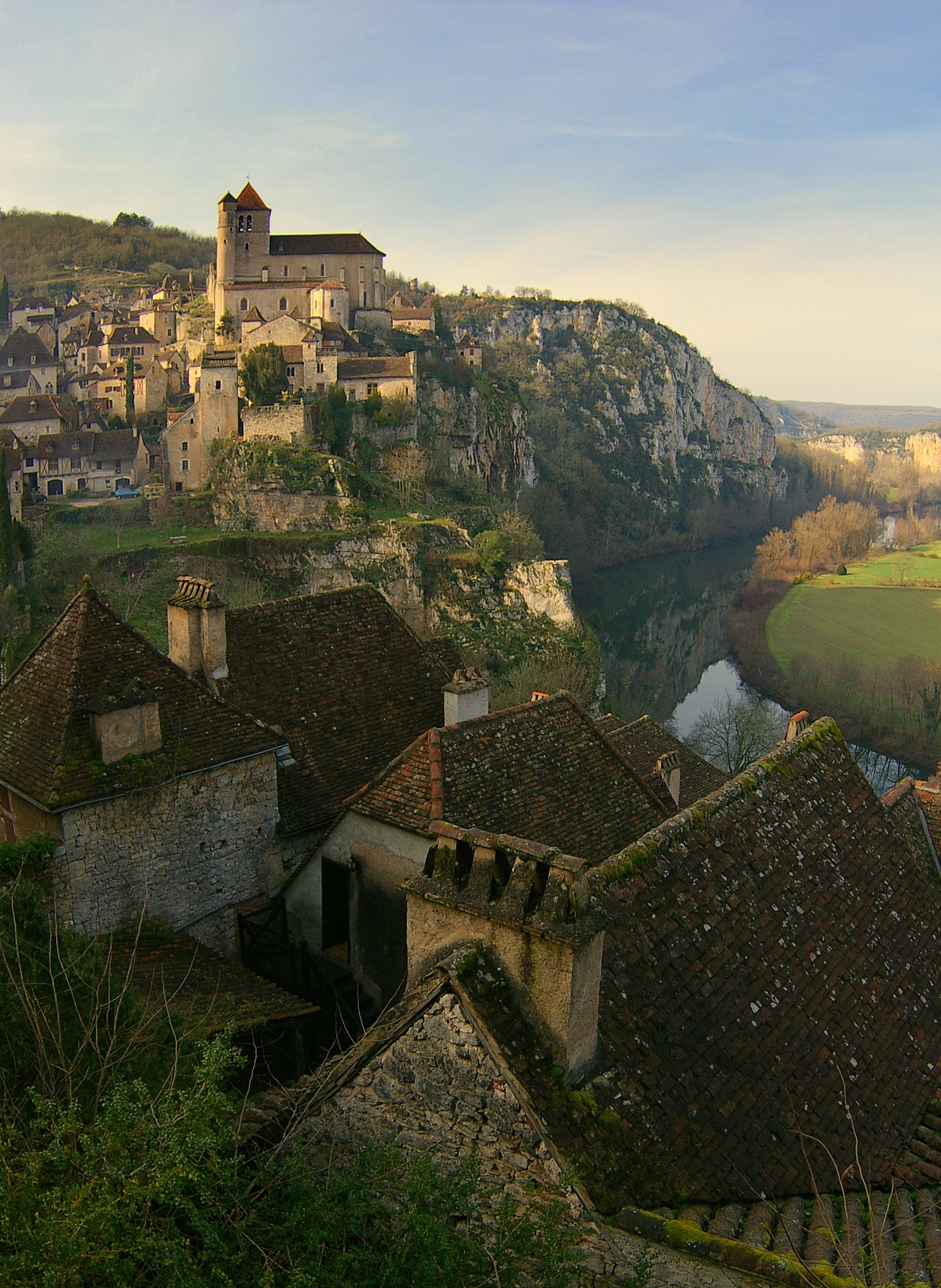
From across the valley, Saint-Cirq-Lapopie can appear to be a single composition: cliff, church, roofs and river. Inside the village, that image breaks into spaces with different jobs. A street opening could serve a shop; an upper room could belong to domestic life; a terrace could manage a difficult slope; a prominent building could express authority. The village was not built merely to be seen from a distance.
For a focused visit, follow the relationship between commercial openings and the houses above them. This reveals a more useful merchant history than assuming that every attractive façade once belonged to a rich trader or that every present-day craft shop continues the same medieval business.
Read the slope before reading the shopfront
The Lot's departmental heritage account describes a settlement below a castle complex on the rocky summit, with the medieval village extending along its main street between fortified entrances. It emphasises the interlocking terraces, retaining structures, ramps and stairs created by the steep site. This is a built settlement negotiating a slope, not a flat market town accidentally placed beside a cliff. Lot heritage portal: Saint-Cirq-Lapopie landscape and urban form.
A useful first observation is to compare the apparent height of a building from two public positions. The ground beside it may rise or fall, changing how its floors meet the street. Do not assume that an entrance at one level served the same function as an opening around the corner.
This also changes the way the river should be understood. Seeing the Lot below does not mean that the space outside a house was a quayside. The cliff village and the river's working edge belong to connected but distinct levels. Establishing the route between them requires more than pointing downhill.
Connected places, different levels. This view makes the separation between the village and the river visible; it does not identify a loading place or a historic cargo route. Adam Baker, Simply Lapopie, 15 January 2007, CC BY 2.0. Original image unchanged.

The Sombral and rue Droite: openings for exchange
The destination's description of the medieval houses identifies arcaded buildings at the place du Sombral and rue Droite, also called Grand Rue. It describes ground-floor shops in houses of the thirteenth or fourteenth century, while noting a later transformation of one timber-framed upper storey. It explicitly says there are no interior visits for these houses. Cahors Vallée du Lot: medieval houses.
At street level, ask how an opening connects inside and outside. Does it provide an entrance, a broad frontage or a narrower passage? Above it, look at the arrangement of windows without assuming that all floors were built or altered together. The combination is more informative than an isolated decorative detail.
A shop opening supports a statement about commercial use. It does not, on its own, identify the goods sold, the owner's wealth or the duration of a business. Those require additional evidence. Nor does a modern display prove that an identical trade occupied the same premises centuries earlier.
The point is not to make looking laborious. It is to replace an attractive but vague label—“medieval merchant house”—with two or three observations that can actually be checked. An opening, a street relationship and an alteration can already tell a substantial story.
One house can expose the limits of the postcard
The regional inventory's study of the Maison Vaillat, also called Maison Vanoy, offers a particularly clear example. It explains that today's isolated house once belonged to a small block shown on the 1841 cadastral plan and discusses later losses and restorations. It treats a proposed fourteenth-century date cautiously, noting limits to the dendrochronological evidence. The present outline therefore cannot simply be projected backwards as an intact medieval scene. Occitanie heritage inventory: Maison Vaillat/Vanoy, IA46000500.
The same study identifies domestic fittings, including a notable wall cupboard, and distinguishes altered fabric from earlier elements. The building is private; its documented interior is not an invitation to enter. The inventory is useful here because it compares plans, photographs and architectural observations rather than letting the current façade answer every question. Maison Vaillat/Vanoy inventory.
Imagine placing a present-day outline beside an older cadastral outline. A missing neighbour changes what looks like an original exposed wall. A restored opening changes what appears to be a surviving medieval feature. Neither makes the building unimportant. It makes its history longer and more complicated than one date.
For an ordinary visit, you do not need to settle each scholarly uncertainty. You do need to avoid converting a tentative dating into a precise building year. Write “proposed,” “altered” or “restored” when that is what the evidence supports.
Trades had their own chronology
The official visitor guide distinguishes the earlier development of woodturning from its later prominence in the nineteenth century, when barrel taps were produced in connection with wine commerce. It also describes other remembered craft activities. The important point is chronological: the village's medieval houses and its later reputation for a particular manufactured item are not automatically the same historical episode. Cahors Vallée du Lot: Saint-Cirq-Lapopie visitor guide.
A barrel tap is a small object with a larger economic context. It is not the wine, the barrel or the boat, but it belongs to the equipment through which a product is stored and handled. Looking at supporting trades is one way to understand commerce without reducing every place in a wine region to vineyards alone.
Keep modern claims equally specific. A current workshop, an old workshop preserved as heritage and an association demonstrating a technique are different arrangements. A tourism page's general reference to a traditional trade does not guarantee that a named maker still works at the same address or offers demonstrations today.
This article does not promise access to a functioning historical woodturner's workshop. If that is the purpose of a visit, confirm the current operator and activity rather than relying on an undated “last artisan” description.
Wine records complicate an all-river story
Research by Patrice Foissac on the Saint-Cirq vineyard cites a September 1499 journey in which servants of Cahors' collège Pélegry used two mounts to obtain four barrels of wine at Saint-Cirq. The author draws attention to the overland journey rather than an assumed upstream river movement. It is a small, dated example, not proof of how every consignment travelled. Société des Études du Lot: the medieval Saint-Cirq vineyard.
The example matters because scenery can make an explanation feel inevitable. A visible river encourages the assumption that all trade used boats. A record of one journey shows why actual transactions deserve attention. The choice of route belongs to a particular task, period and set of circumstances.
The original archive documents cited in that study have not been inspected for this article. For a deeper enquiry, use its references to identify the relevant record and consult the repository's access conditions. A modern summary should not be presented as a transcription of an unseen original.
The art houses are another layer, not a medieval shop museum
The Centre international du surréalisme et de la citoyenneté mondiale explains the later artistic history of the Maison Breton and Maison Rignault. For Rignault, it describes a neo-Gothic remodelling, with much of the present arrangement resulting from the collector's work in the first half of the twentieth century. It identifies Maison Breton with the poet's summer stays between 1951 and 1966. These houses offer evidence about later uses and perceptions of the village. CISCM: the houses.
That makes them relevant to a visit centred on merchant history, but not because they reconstruct a complete medieval trading household. They show how later residents and collectors selected, changed and valued older places. An evocative room can be historically important without belonging to the period suggested by its atmosphere.
When viewing an interior, ask which date belongs to the building, which to its arrangement and which to the displayed object. Those dates may differ. A collector's furniture should not be silently turned into evidence of what a medieval shopkeeper owned.
Check the centre's current visitor information for exhibitions and admission. Older museum brochures are evidence of earlier programming, not a reliable calendar for a present visit.
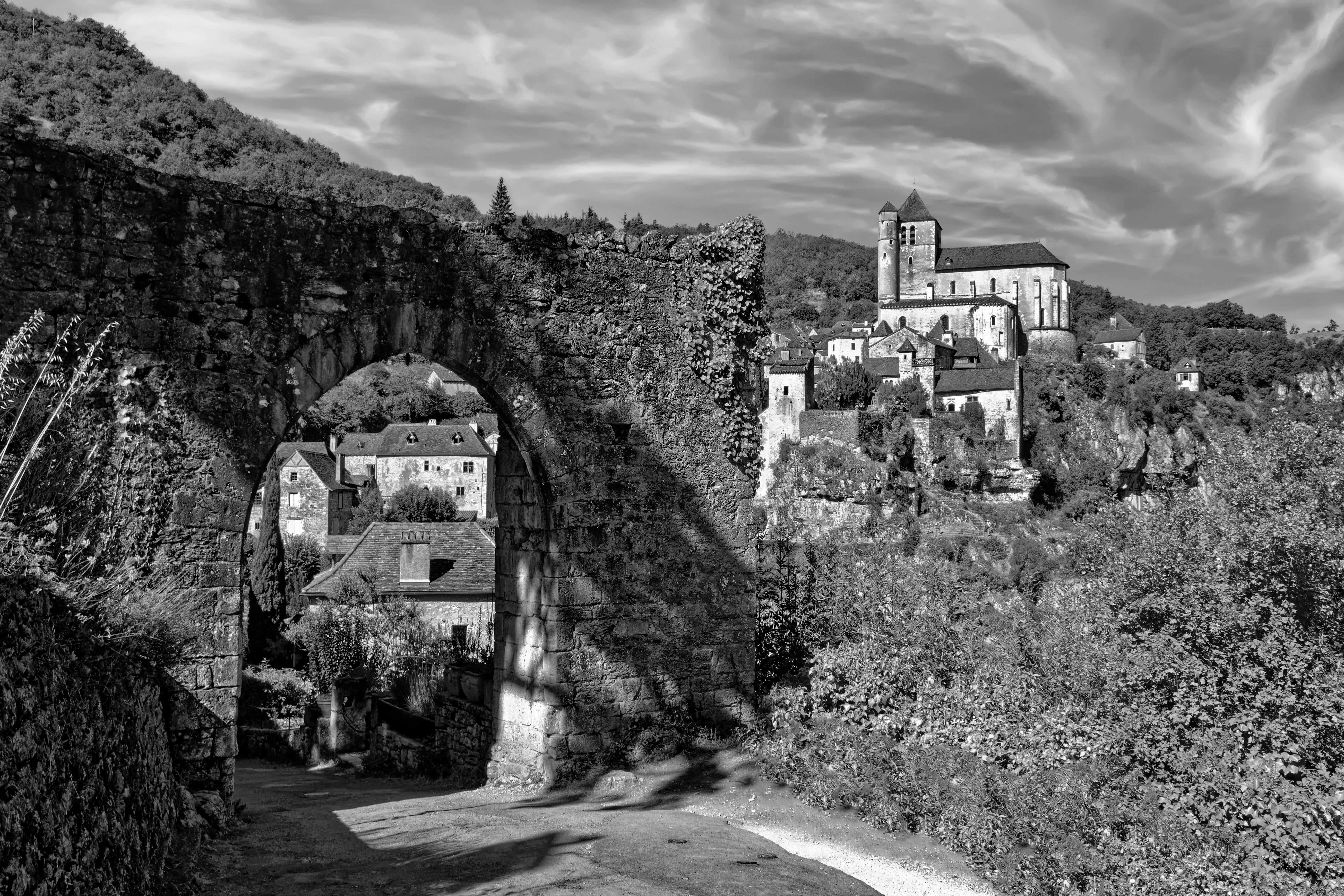
An opening is not automatically a shopfront. The photographer identifies this as the Porte de Rocamadour: a useful contrast with the commercial openings discussed earlier. The photograph alone cannot date every stone or certify current access. Eric Huybrechts, Saint-Cirq-Lapopie — Porte de Rocamadour, 6 August 2020, CC BY-ND 2.0. Original monochrome photograph unchanged, uncropped and unannotated.
Make a short, evidence-led circuit
Begin with the Sombral and the street relationship described in the official house listing. Observe from public space, then compare one named building with its inventory record. If a cultural house is open and fits your interests, use it to examine the village's later reinvention rather than forcing it into the medieval chapter.
| What you encounter | A useful question | An unsupported shortcut | |---|---|---| | Ground-floor arcade | What use is documented for this opening? | Every arch was the same kind of shop | | Timber-framed upper level | Which phase does the record identify? | The entire house has one date | | Isolated old house | Did it once have adjoining buildings? | Its present outline is the original block | | Craft interpretation | Which trade and century are being discussed? | Every traditional product is medieval | | Art-house interior | Who arranged it, and when? | Its appearance reconstructs merchant life |
The municipality directs vehicles to designated parking areas above and below the village and prohibits general parking in the village and on surrounding roads. Choose an authorised arrival point and check current conditions; a scenic address does not guarantee a level approach. Municipality: access and parking.
For orientation, use the Place du Sombral, Saint-Cirq-Lapopie location search. It is a place-name search, not a surveyed pin, rendered map, parking instruction or accessibility certification.
The village's merchant history is strongest when it is not flattened into an unchanging medieval scene. Street openings, domestic spaces, craft products and later restorations belong to different but connected stories. Reading those connections lets the cliff village remain a lived and altered place, rather than a beautiful image with every century folded into one.
Source register and limits
Remote research used the heritage inventory, departmental landscape interpretation, municipal access information, official visitor guide and cultural-house operator. The official 2024 guide PDF was acquired and relevant text read. Foissac’s archive-based account was consulted as indexed text, not as original archival records. No physical inspection or interior permission is claimed. Tentative building dates, later restorations and nineteenth-century barrel-tap prominence remain distinct. Current woodturner availability is not established. Both photographs retain their exact original bytes and licence attribution; neither verifies current access or a merchant identity.