Free · France
Auvillar: Clocktower and pilgrimage town history
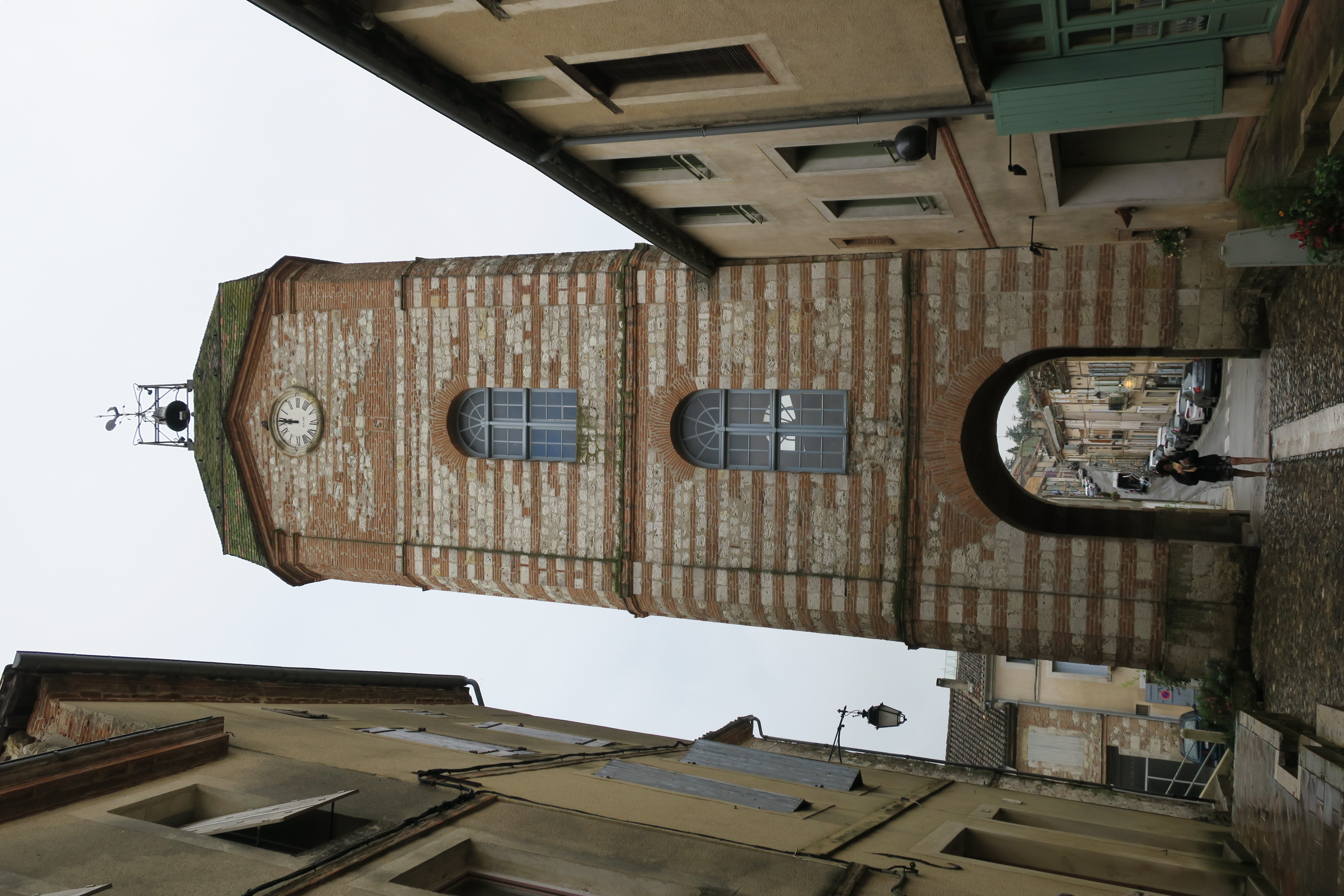
A gateway is a good place to ask who enters a town—and a poor place to assume that everyone once entered for the same reason. Auvillar's Tour de l'Horloge belongs to a settlement shaped by river work, commerce, religious life and, today, the movement of walkers on the way towards Compostela. Those histories intersect, but the tower is not simply a purpose-built monument to pilgrimage.
Look at it in three layers: the older town entrance, the later tower and the present-day services that make Auvillar a stopping place. Each layer needs its own evidence. Together they explain more than an imagined procession of medieval pilgrims passing beneath an unchanged clock.
An old gateway site does not give the tower a medieval date
The Ministry of Culture's protection record dates the clocktower to the eighteenth century, on the site of the Porte d'Arnaud Othon, an entrance associated with the town's former fortifications. It describes rooms arranged above a porch. The regional architectural inventory also assigns the principal construction to the eighteenth century and identifies mixed stone-and-brick fabric. Protection record PA00095703; inventory IA00039299.
There is a discrepancy worth making explicit. The municipal heritage introduction calls the monumental gate seventeenth-century, while the two Ministry records give the eighteenth. This article follows the latter with attribution; it does not claim that a building account has resolved the disagreement. The secure distinction is between an earlier entrance site and the later tower that occupies it. Municipality: local heritage.
This matters because a name can survive rebuilding. The continued use of a gateway's name does not prove that its masonry, clock or upper rooms all belong to the same century. A photograph of the current structure cannot settle that sequence on its own.
Read a threshold, not an imaginary checkpoint
A porch with rooms above is both passage and building. It makes an entrance conspicuous while giving the structure a presence beyond the opening at street level. That is a reading of its form, not proof of particular historic duties performed in each room.
Ask what evidence would be needed to go further. A claim that someone collected a fee here needs a dated record of that fee and its location. A claim about curfews needs rules governing opening and closing. A claim that a clock regulated a particular commercial activity needs more than the existence of a dial. None of those local practices has been established from an original administrative record for this article.
The tower's protected status is precise: its façades and roofs were registered as historic-monument fabric by an order of 1 February 1978. That is not the same as saying the entire interior was classified or is continuously open to visitors. Ministry protection record.
For an exterior reading, distinguish the passage, upper storeys and roofline. Note changes in materials or openings without assigning dates by eye. A repair can resemble older work; an old-looking feature can also have been restored. The inventory itself records restoration, so an interpretation based on “untouched medieval fabric” would be especially misleading. Regional inventory.
Read the tower from street level. The passage, upper rooms and clock are visible together in this photograph from 10 July 2017. The image illustrates the building's form; it cannot resolve the competing construction dates or establish the purpose of any passer-by's journey. Photograph by 13okouran, Auvillar - Tour de l'Horloge, CC BY-SA 4.0. Original photograph unchanged; present-day access is not verified by this historical view.

The tower also connects to the river's religious culture
The Ministry's protected-object register associates the tower with a painting of Saint Catherine as patron of boatmen and two model vessels recorded as ex-votos. These objects introduce a different kind of movement from walking to Compostela: the working and devotional world of people connected with navigation. The register is evidence of catalogued objects and locations, not a live display inventory guaranteeing what can be seen today. Ministry of Culture: protected objects in Auvillar.
The local museum's account discusses offerings associated with the port chapel and the preservation of a Saint Catherine painting and vessel models. It explains why maritime imagery belongs in Auvillar's cultural history even though the village is inland. Musée du Vieil Auvillar: inland waterways.
A useful comparison is between an object offered in devotion and an image used to identify a walking route. Both may be religious in subject, but neither should be substituted for the other. A model ship does not prove that its donor travelled to Compostela. A pilgrim figure on a present-day façade does not establish the age of the wall behind it.
This is how the tower can broaden a pilgrimage story rather than merely decorate it. A walker entering Auvillar encounters a place whose inhabitants had other journeys, livelihoods and devotional affiliations. The route is part of the town, not the town's only explanation.
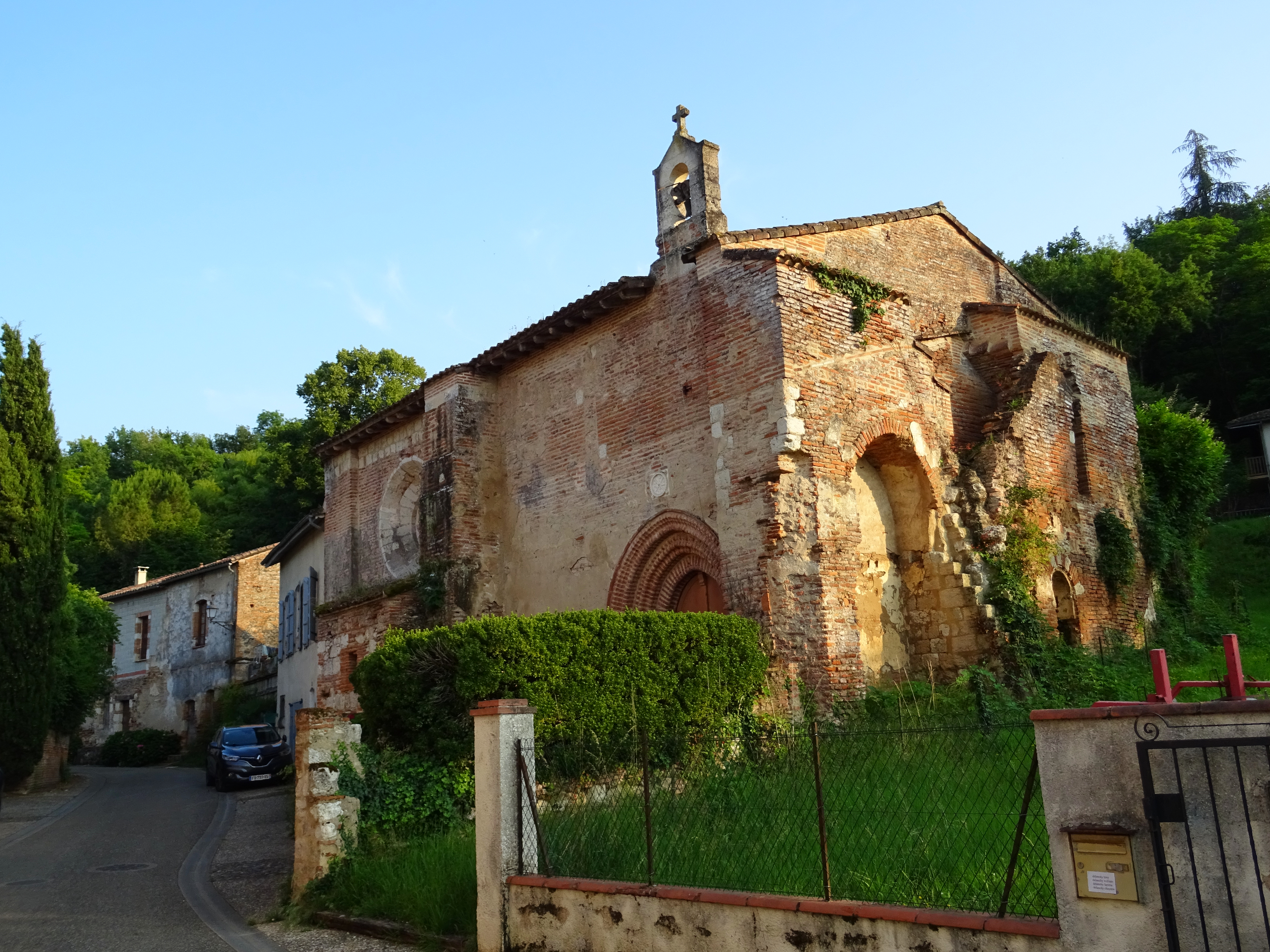
A separate place of devotion. This is the port-quarter chapel, not the clocktower or a pilgrim hostel. Its exterior gives a spatial reference for the river community discussed here; it does not show the catalogued objects or establish their current display. Olive Titus, Chapelle Sainte-Catherine du Port, Le Port, Auvillar, Tarn-et-Garonne, 9 June 2025, CC BY 2.0. Original photograph unchanged.
Today's route is a documented reality, not proof of every medieval footstep
The Agence française des chemins de Compostelle identifies Auvillar with the Voie du Puy-en-Velay, GR65, and as a halt between Moissac and Lectoure. It also identifies the commune's “Communes Haltes” label in relation to reception, facilities and services for walkers and pilgrims. Agency: Auvillar.
Those contemporary facts are valuable in their own right. They do not require a claim that the exact present trail follows an unchanged medieval line at every point. The agency's historical guidance urges care in using the medieval Codex Calixtinus as though it were a modern route guide and explains the later reception of its famous fifth book. Agency: contemporary routes and their sources.
For Auvillar, the sensible distinction is therefore between a historically meaningful pilgrimage tradition and a fully documented individual itinerary. To claim that a particular person passed through a particular gate would require a travel account, register or other specific evidence. Neither a modern waymark nor a general medieval narrative supplies that evidence automatically.
The distinction also protects living heritage from being treated as a disappointing imitation. Present-day hospitality, route maintenance and local artistic responses are real cultural activity. They do not become less worthwhile because they are contemporary.
Hospitality is an arrangement people maintain
The municipal pilgrimage page describes small pilgrim figures around the village and facilities for rest, bicycle storage and phone charging. It also distinguishes a communal overnight gîte from a daytime stopping space. These are different services: a place to sit or charge a device is not necessarily a place to sleep. Municipality: pilgrimage and reception.
This is the practical side of a pilgrimage town. Someone must make information available, maintain a building and organise arrival. Looking only at monuments risks overlooking that work. It also encourages travellers to assume that a historic label guarantees an available bed, an open door or year-round reception.
A specific dated example shows why that assumption fails. The agency's entry for the communal Le Presbytère gîte lists a 2026 reception period from 14 April to 6 October and describes it as reserved for people making the Compostela pilgrimage. As checked on 27 October 2026, that published season has ended; the listing is not evidence of current late-October availability. Confirm arrangements directly; a general village description does not establish availability for your intended date. Agency: communal gîte.
The municipal daytime-facility page also gives more than one opening-hours formulation. Rather than selecting a convenient one, check with the tourist office for the intended date. A heritage article should not turn an ambiguous webpage into a promise that someone will be there to receive a tired walker.
Four questions to carry through the gateway
| What you notice | The useful question | Evidence needed before claiming more | |---|---|---| | A tower over an entrance | Which part is dated, and which earlier structure occupied the site? | Architectural inventory or dated building records | | A devotional object connected with boatmen | What kind of journey or community does this represent? | Object provenance, dedication and museum interpretation | | A pilgrim figure or route sign | Is this a current marker, a recent artwork or an older object? | A label, commission record or documented date | | A reception facility | Who may use it, and when is it available? | Current operator conditions and confirmation |
These questions keep observation separate from a conclusion. They also make a short visit possible without pretending to reconstruct every period. Concentrate on the difference between the gateway's historical layers and the town's present reception arrangements; leave the grain hall and river-cargo economy for their own investigations.
Orientation without an access guarantee
Use Tour de l'Horloge, Auvillar on Google Maps as an address-search aid. It is not a rendered or verified entrance pin, a pedestrian safety assessment or confirmation of tower-interior opening. For walking onward, use current route information and local waymarking rather than treating this article as turn-by-turn navigation.
Historic streets remain places where people live and work. Do not block a passage while photographing it, enter private doorways to follow an imagined old route or assume that a religious building is available for unrestricted photography. The cultural meaning of hospitality includes respecting the boundaries of those who provide it.
Auvillar's clocktower is most interesting when it does not carry the whole weight of an invented pilgrimage past. It marks a threshold with its own rebuilding history, preserves connections to a river community and stands within a town that actively receives walkers today. Those are three distinct stories. Reading them together, without erasing their differences, gives the place its depth.
Source register and limits
Remote research used Ministry inventory/protection and object listings, municipal pilgrimage information, museum interpretation and the French Compostela agency. The municipal heritage dating was available as indexed official text; its direct page returned403, so not every page was directly read. No original medieval itinerary, building account, municipal register, interview or museum visit is claimed. Seventeenth- versus eighteenth-century dating remains unresolved; protection covers façades and roofs rather than every interior. Published2026 lodging dates and ambiguous daytime hours are not current availability guarantees. Two dated authentic photographs retain their original bytes and credits; neither establishes a pilgrim itinerary or current access.